[av_hr class=’invisible’ height=’5′ shadow=’no-shadow’ position=’center’ custom_border=’av-border-thin’ custom_width=’50px’ custom_border_color=” custom_margin_top=’30px’ custom_margin_bottom=’30px’ icon_select=’yes’ custom_icon_color=” icon=’ue808′ font=’entypo-fontello’ admin_preview_bg=”]
[av_image src=’https://onefamily.ie/wp-content/uploads/2020/10/Budget2021_noborder_webbanner.jpg’ attachment=’19263′ attachment_size=’full’ align=’center’ styling=” hover=” link=” target=” caption=” font_size=” appearance=” overlay_opacity=’0.4′ overlay_color=’#000000′ overlay_text_color=’#ffffff’ animation=’no-animation’ admin_preview_bg=”][/av_image]
[av_hr class=’invisible’ height=’60’ shadow=’no-shadow’ position=’center’ custom_border=’av-border-thin’ custom_width=’50px’ custom_border_color=” custom_margin_top=’30px’ custom_margin_bottom=’30px’ icon_select=’yes’ custom_icon_color=” icon=’ue808′ font=’entypo-fontello’ admin_preview_bg=”]
[av_textblock size=” font_color=” color=” av-medium-font-size=” av-small-font-size=” av-mini-font-size=” admin_preview_bg=”]
Budget fails to provide income security for most vulnerable families
[/av_textblock]
[av_hr class=’invisible’ height=’25’ shadow=’no-shadow’ position=’center’ custom_border=’av-border-thin’ custom_width=’50px’ custom_border_color=” custom_margin_top=’30px’ custom_margin_bottom=’30px’ icon_select=’yes’ custom_icon_color=” icon=’ue808′ font=’entypo-fontello’ admin_preview_bg=”]
[av_textblock size=” font_color=” color=” av-medium-font-size=” av-small-font-size=” av-mini-font-size=” admin_preview_bg=”]
Budget 2021 was a missed opportunity to provide income security for Ireland’s poorest families. National statistics consistently highlight one-parent families as among the worst off in society and children in these families being particularly vulnerable to poverty and deprivation. Since 2016, there have been 12 major reports on lone parents and poverty all with similar recommendations. While Budget 2021 has some welcome measures; Government have not used the evidence available to them. Parents and children are struggling now and will continue to do so after this Budget. The Budget does little to help working lone parents keep their job if their children are sick and contains no targeted supports for one-parent families and nothing on childcare – the most pressing issue for working lone parents.
[/av_textblock]
[av_hr class=’invisible’ height=’10’ shadow=’no-shadow’ position=’center’ custom_border=’av-border-thin’ custom_width=’50px’ custom_border_color=” custom_margin_top=’30px’ custom_margin_bottom=’30px’ icon_select=’yes’ custom_icon_color=” icon=’ue808′ font=’entypo-fontello’ admin_preview_bg=”]
[av_textblock size=” font_color=” color=” av-medium-font-size=” av-small-font-size=” av-mini-font-size=” admin_preview_bg=”]
Karen Kiernan CEO of One Family said, “We welcome that Government listened (even partially) to us and made necessary increases to the Qualified Child Increase (QCI) and Fuel Allowance. We are disappointed that the Working Family Payment (WFP) has not been adjusted to support people parenting alone although the increase is welcome. And we welcome the change to the One-Parent Family Payment (OFP) though this will impact only a small number of parents. But we are concerned that Government is not using the evidence available and seems happy to adopt a scattergun approach rather than introduce targeted measures for the most vulnerable. Budget 2021 does nothing to lift families currently living in poverty out of it. It maintains the status quo; but the status quo kept thousands of children in poverty. We had hoped for a strategic and progressive vision of the future with targeted measures for the most vulnerable, what we got was a little for everyone.”
[/av_textblock]
[av_hr class=’invisible’ height=’10’ shadow=’no-shadow’ position=’center’ custom_border=’av-border-thin’ custom_width=’50px’ custom_border_color=” custom_margin_top=’30px’ custom_margin_bottom=’30px’ icon_select=’yes’ custom_icon_color=” icon=’ue808′ font=’entypo-fontello’ admin_preview_bg=”]
[av_textblock size=” font_color=” color=” av-medium-font-size=” av-small-font-size=” av-mini-font-size=” admin_preview_bg=”]
“We understand the difficult decisions Government must make in the midst of a double threat of the pandemic and Brexit but Ireland’s most vulnerable families need targeted supports. We call on Government to use the evidence that is available.”
/End/
[/av_textblock]
[av_hr class=’invisible’ height=’10’ shadow=’no-shadow’ position=’center’ custom_border=’av-border-thin’ custom_width=’50px’ custom_border_color=” custom_margin_top=’30px’ custom_margin_bottom=’30px’ icon_select=’yes’ custom_icon_color=” icon=’ue808′ font=’entypo-fontello’ admin_preview_bg=”]
[av_textblock size=” font_color=” color=” av-medium-font-size=” av-small-font-size=” av-mini-font-size=” admin_preview_bg=”]
“We understand the difficult decisions Government must make in the midst of a double threat of the pandemic and Brexit but Ireland’s most vulnerable families need targeted supports. We call on Government to use the evidence that is available.”
/End/
[/av_textblock]
[av_hr class=’invisible’ height=’30’ shadow=’no-shadow’ position=’center’ custom_border=’av-border-thin’ custom_width=’50px’ custom_border_color=” custom_margin_top=’30px’ custom_margin_bottom=’30px’ icon_select=’yes’ custom_icon_color=” icon=’ue808′ font=’entypo-fontello’ admin_preview_bg=”]
[av_textblock size=” font_color=” color=” av-medium-font-size=” av-small-font-size=” av-mini-font-size=” admin_preview_bg=”]
Note to editors:
[/av_textblock]
[av_hr class=’invisible’ height=’10’ shadow=’no-shadow’ position=’center’ custom_border=’av-border-thin’ custom_width=’50px’ custom_border_color=” custom_margin_top=’30px’ custom_margin_bottom=’30px’ icon_select=’yes’ custom_icon_color=” icon=’ue808′ font=’entypo-fontello’ admin_preview_bg=”]
[av_textblock size=” font_color=” color=” av-medium-font-size=” av-small-font-size=” av-mini-font-size=” admin_preview_bg=”]
About One Family:
[/av_textblock]
[av_hr class=’invisible’ height=’10’ shadow=’no-shadow’ position=’center’ custom_border=’av-border-thin’ custom_width=’50px’ custom_border_color=” custom_margin_top=’30px’ custom_margin_bottom=’30px’ icon_select=’yes’ custom_icon_color=” icon=’ue808′ font=’entypo-fontello’ admin_preview_bg=”]
[av_textblock size=” font_color=” color=” av-medium-font-size=” av-small-font-size=” av-mini-font-size=” admin_preview_bg=”]
One Family is Ireland’s organisation for people parenting alone, sharing parenting and separating, offering support, information and services to all members of all one-parent families, to those sharing parenting, to those experiencing an unplanned pregnancy and to professionals working with one-parent families. Children are at the centre of One Family’s work and the organisation helps all the adults in their lives, including mums, dads, grandparents, step-parents, new partners and other siblings, offering a holistic model of specialist family support services.
[/av_textblock]
[av_hr class=’invisible’ height=’10’ shadow=’no-shadow’ position=’center’ custom_border=’av-border-thin’ custom_width=’50px’ custom_border_color=” custom_margin_top=’30px’ custom_margin_bottom=’30px’ icon_select=’yes’ custom_icon_color=” icon=’ue808′ font=’entypo-fontello’ admin_preview_bg=”]
[av_textblock size=” font_color=” color=” av-medium-font-size=” av-small-font-size=” av-mini-font-size=” admin_preview_bg=”]
These services include the lo-call askonefamily national helpline on 1890 662212, counselling, and provision of training courses for parents and for professionals.
[/av_textblock]
[av_hr class=’invisible’ height=’30’ shadow=’no-shadow’ position=’center’ custom_border=’av-border-thin’ custom_width=’50px’ custom_border_color=” custom_margin_top=’30px’ custom_margin_bottom=’30px’ icon_select=’yes’ custom_icon_color=” icon=’ue808′ font=’entypo-fontello’ admin_preview_bg=”]
[av_textblock size=” font_color=” color=” av-medium-font-size=” av-small-font-size=” av-mini-font-size=” admin_preview_bg=”]
Read One Family’s Pre-Budget Submission.
Read our Budget 2021 Factsheet.
[/av_textblock]
[av_hr class=’invisible’ height=’30’ shadow=’no-shadow’ position=’center’ custom_border=’av-border-thin’ custom_width=’50px’ custom_border_color=” custom_margin_top=’30px’ custom_margin_bottom=’30px’ icon_select=’yes’ custom_icon_color=” icon=’ue808′ font=’entypo-fontello’ admin_preview_bg=”]
[av_textblock size=” font_color=” color=” av-medium-font-size=” av-small-font-size=” av-mini-font-size=” admin_preview_bg=”]
Statistics on one-parent families:
[/av_textblock]
[av_hr class=’invisible’ height=’10’ shadow=’no-shadow’ position=’center’ custom_border=’av-border-thin’ custom_width=’50px’ custom_border_color=” custom_margin_top=’30px’ custom_margin_bottom=’30px’ icon_select=’yes’ custom_icon_color=” icon=’ue808′ font=’entypo-fontello’ admin_preview_bg=”]
[av_textblock size=” font_color=” color=” av-medium-font-size=” av-small-font-size=” av-mini-font-size=” admin_preview_bg=”]
There were 218,817 family units with children (of any age) headed by a lone parent (Census 2016).
[/av_textblock]
[av_hr class=’invisible’ height=’10’ shadow=’no-shadow’ position=’center’ custom_border=’av-border-thin’ custom_width=’50px’ custom_border_color=” custom_margin_top=’30px’ custom_margin_bottom=’30px’ icon_select=’yes’ custom_icon_color=” icon=’ue808′ font=’entypo-fontello’ admin_preview_bg=”]
[av_textblock size=” font_color=” color=” av-medium-font-size=” av-small-font-size=” av-mini-font-size=” admin_preview_bg=”]
- 1 in 4 families with children in Ireland is a one-parent family (Census 2016).
- 1 in 5 people in Ireland live in a one-parent family (Census 2016).
- 356,203 children lived in one-parent families, representing more than one in five or 21.2% of all children in family units (Census 2016).
- In November 2018, 14,349 One-Parent Family Payment recipients (39 per cent of all recipients) are in employment, and of 14,418 Jobseeker’s Transition recipients, 4,037 recipients work. The Working Family Payment is an important support for working parents; almost half of recipients are households headed by a lone parent.
- The Survey on Income and Living Conditions 2017 (SILC) revealed that one-parent family households experience the most deprivation in Ireland. Almost 45% of lone parent households experience more than one form of deprivation.
- 55% of homeless families living in emergency accommodation are one-parent families, at any time.
[/av_textblock]
[av_hr class=’invisible’ height=’30’ shadow=’no-shadow’ position=’center’ custom_border=’av-border-thin’ custom_width=’50px’ custom_border_color=” custom_margin_top=’30px’ custom_margin_bottom=’30px’ icon_select=’yes’ custom_icon_color=” icon=’ue808′ font=’entypo-fontello’ admin_preview_bg=”]
[av_textblock size=” font_color=” color=” av-medium-font-size=” av-small-font-size=” av-mini-font-size=” admin_preview_bg=”]
For further information visit: www.onefamily.ie.
[/av_textblock]
[av_hr class=’invisible’ height=’30’ shadow=’no-shadow’ position=’center’ custom_border=’av-border-thin’ custom_width=’50px’ custom_border_color=” custom_margin_top=’30px’ custom_margin_bottom=’30px’ icon_select=’yes’ custom_icon_color=” icon=’ue808′ font=’entypo-fontello’ admin_preview_bg=”]
[av_two_third first min_height=” vertical_alignment=’av-align-top’ space=” margin=’0px’ margin_sync=’true’ padding=’0px’ padding_sync=’true’ border=’18’ border_color=’#f2f2f2′ radius=’0px’ radius_sync=’true’ background_color=’#f2f2f2′ src=” attachment=” attachment_size=” background_position=’top left’ background_repeat=’no-repeat’ animation=” mobile_breaking=” mobile_display=”]
[av_textblock size=” font_color=” color=” av-medium-font-size=” av-small-font-size=” av-mini-font-size=” admin_preview_bg=”]
Available for Interview
[/av_textblock]
[av_textblock size=” font_color=” color=” av-medium-font-size=” av-small-font-size=” av-mini-font-size=” admin_preview_bg=”]
Karen Kiernan, CEO | t: 01 662 9212 or 086 850 9191
[/av_textblock]
[av_hr class=’invisible’ height=’10’ shadow=’no-shadow’ position=’center’ custom_border=’av-border-thin’ custom_width=’50px’ custom_border_color=” custom_margin_top=’30px’ custom_margin_bottom=’30px’ icon_select=’yes’ custom_icon_color=” icon=’ue808′ font=’entypo-fontello’ admin_preview_bg=”]
[av_textblock size=” font_color=” color=” av-medium-font-size=” av-small-font-size=” av-mini-font-size=” admin_preview_bg=”]
Further Information/Scheduling
[/av_textblock]
[av_textblock size=” font_color=” color=” av-medium-font-size=” av-small-font-size=” av-mini-font-size=” admin_preview_bg=”]
Noel Sweeney, Communications and Events Manager | t: 01 622 9212 or 085 7241294
[/av_textblock]
[/av_two_third]
[av_hr class=’invisible’ height=’60’ shadow=’no-shadow’ position=’center’ custom_border=’av-border-thin’ custom_width=’50px’ custom_border_color=” custom_margin_top=’30px’ custom_margin_bottom=’30px’ icon_select=’yes’ custom_icon_color=” icon=’ue808′ font=’entypo-fontello’ admin_preview_bg=”]
As the economy re-opens and people are called back to work, we are asking parents to complete a quick two-minute survey about their childcare concerns and whether they think it will impact their income/job security.
To fill out this anonymous survey click here:
We are looking to quantify parents’ concerns as part of the #ChildcarePreventsHomelessness campaign with Focus Ireland, Children’s Right Alliance, Barnardos Ireland, Treoir, FLAC, Dress for Success and the National Women’s Council of Ireland.
A report from the Department of Children and Youth Affairs states that lone parents are at increased risk of poverty. The report draws from existing data and literature to provide an understanding of what we know about the situation of children living in poverty. It also identifies the main risk factors for experiencing child poverty that can be used to inform future policy developments. A summary of the key findings in relation to one-parent families is outlined below.
Key Findings
- In 2018, 26.7 per cent of children are at risk of living at or below the 70% poverty line, 15.8 per cent of children are at risk of living at or below the 60% poverty line and 7.4 per cent of children are at risk of living in deep poverty – at or below the 50% poverty line.
- Children living in households headed by a lone parent have substantially higher levels of poverty than children living in other family structures.
- Level of education and employment status play a significant role, and studies have shown that lone parents are less likely to hold higher education degrees and also experience higher levels of unemployment. This has a compounding effect that puts lone parents and their children at greater risk of experiencing poverty and deprivation.
- Access to childcare services also plays a role, as households with children that do not make use of childcare services show higher than average rates of child poverty compared to households with children that use childcare.
- Lone parent households are four times as likely to experience income poverty than coupled households.
- Lone parent households are five times as likely to experience material deprivation and consistent poverty.
- Lone parent households are more likely to experience financial exclusion. They are less likely to hold a bank account or have savings and have limited access to low-cost sources of credit.
- The ‘Growing up in Ireland’ study found that levels of economic vulnerability were highest among lone parent families (and higher again for those with two or more children), primary caregivers under the age of 25 when the study child was born, and among primary caregivers with low levels of education.
As we can see, living in a household headed by a lone parent clearly influences the likelihood of a child experiencing poverty, particularly where the parent also has a lower level of education or a lack of reliable employment. This should not be the case, and these dynamics require more attention in the Irish context in terms of both policy and research.
Policy and Service Implications
While poverty among children has shown modest improvement since 2011, the current level of child poverty in society is unacceptable.
Some policy implications outlined in the report include:
- Specific policy actions are urgently required to address child poverty and the variation in poverty risk across age-groups of children in Ireland. The findings presented here suggest that policy measures that were taken to reduce child poverty among very young children (0-5) were successful. This same commitment needs to be extended to all age groups of children and across all domains of children’s lives.
- While socio-economic status and the employment situation of families has attracted considerable attention in policy and research circles, greater attention must be paid in the Irish context to how child poverty impacts one-parent families and how it operates along migration, minority ethnic, or racial lines.
- The employment situation of the household and the education level of the parent or caregiver continue to be strong indicators of child poverty. There is need for policy development in the areas of labour market activation, and in-work benefits to determine their effectiveness in reducing child poverty. Research cautions that a work-first approach that seeks to alleviate poverty by moving people off welfare and into work as quickly as possible ignores the critical role that high-quality education and training play in achieving self-sufficiency, especially for the most vulnerable populations. Thus, room for educational development and training opportunities is essential in any welfare to work strategy.
- There is a clear need to enhance access to affordable all-day childcare, particularly for low-income families.
- It is well established that several policy mechanisms are required to produce a reduction in child poverty, involving policy that spans a range of Government Departments. A multidimensional approach to the reduction of child poverty will require continuing emphasis on a cross-departmental approach among departments that support public policies for families and children
The full report, Income, Poverty and Deprivation among Children – A Statistical Baseline Analysis, can be found here: https://www.gov.ie/en/publication/a1580-income-poverty-and-deprivation-among-children-a-statistical-baseline-analysis-july-2020/
One Family’s tips on how to make blended families work was featured in an article by Sheila Wayman in the Irish Times on Wednesday 2 September. The article featured comment by One Family’s CEO Karen Kiernan on how to make blended families work – to read the article click: Irish Times article:
Meanwhile, our helpline staff have come up with a list of books that parents could find helpful when starting conversations with children about blended and shared families. Diverse families: onefamily.ie/booklist/diver and Blended Families: onefamily.ie/booklist/blend
One Family’s tips on how to make blended families work:
- Never presume just because you as adults are in a good relationship that your children will be overjoyed to meet your new partner’s children;
- Ensure your couple relationship is strong and stable before subjecting children to a blended family. You will need to agree how you both play a role in parenting each other’s children, especially if they are young and you are left in charge at times;
- It must be made very clear to children that new partners are not replacing mum/dad. They should always call the new partner by their first name;
- Children usually choose who they become friends with, so being landed with someone else’s children all of a sudden is not easy and they may not get along. Yet they need to feel at home in each parent’s home;
- Children want to spend time with parents and not always with new blended families, unless you are very lucky. Sharing you may be a challenge;
- If you have no children but are moving in with your new partner and their children, you need to do it in stages. It is a bit like being an uncle/aunt. You need to support the children to have a good relationship with both biological parents and extended family – this comes before your family;
- Couple time is crucial. If you get caught up in childcare and parenting with no time as a couple, you will fall down. You must have a strong relationship, take time to talk and compromise, so you can parent children in the one home and meet their needs;
- Include children in the planning to become a blended family. Include the other parent(s) in this plan too;
- Explain family forms to children – do not presume they get it. Be factual and help them understand about whose mum/dad is whose biologically and otherwise, about step siblings and grandparents etc Help them explain their family form to others and to feel proud of the family form they belong to.
For more parenting tips click here:
[av_image src=’https://onefamily.ie/wp-content/uploads/2020/08/AR_WebBanner.jpg’ attachment=’18958′ attachment_size=’full’ align=’center’ styling=” hover=” link=” target=” caption=” font_size=” appearance=” overlay_opacity=’0.4′ overlay_color=’#000000′ overlay_text_color=’#ffffff’ animation=’no-animation’ admin_preview_bg=”][/av_image]
[av_hr class=’invisible’ height=’30’ shadow=’no-shadow’ position=’center’ custom_border=’av-border-thin’ custom_width=’50px’ custom_border_color=” custom_margin_top=’30px’ custom_margin_bottom=’30px’ icon_select=’yes’ custom_icon_color=” icon=’ue808′ font=’entypo-fontello’ admin_preview_bg=”]
[av_textblock size=” font_color=” color=” av-medium-font-size=” av-small-font-size=” av-mini-font-size=” admin_preview_bg=”]
Specialist Employability programme for Lone Parents sees 90% success rate
[/av_textblock]
[av_hr class=’invisible’ height=’15’ shadow=’no-shadow’ position=’center’ custom_border=’av-border-thin’ custom_width=’50px’ custom_border_color=” custom_margin_top=’30px’ custom_margin_bottom=’30px’ icon_select=’yes’ custom_icon_color=” icon=’ue808′ font=’entypo-fontello’ admin_preview_bg=”]
[av_textblock size=” font_color=” color=” av-medium-font-size=” av-small-font-size=” av-mini-font-size=” admin_preview_bg=”]
The award-winning, European Social Fund -funded, New Futures Employability Programme, for lone parents on social welfare has seen over 90% of graduates progress to education or employment. The programme run by charity, One Family, recorded an 85% success rate in 2018 and new figures further show the phenomenal success of the community-based programme. The figures are revealed in the charity’s Annual Report for 2019 which has just been released. The programme uses a ‘one-to-one’ mentoring system to support lone parents who are looking to return to education or work as well as an accredited training programme and wrap around family support services.
Niamh Wynne, Coordinator of the New Futures Employability Programme said, “Many of the parents we work with are experiencing poverty,domestic abuse, homelessness and social isolation. Despite the incredibly difficult circumstances they are in, all are motivated to change and improve their situations. The New Futures Employability Programme provides the skills, challenges and support they need to build their confidence to take the next step for their family.”
New Futures graduate Tracy*said, “Before starting with One Family in 2019 I had left a relationship due to domestic violence. I had two very young kids and I was only starting to gain back some of the confidence I had lost. I saw a post on Facebook for the New Steps programme and decided to apply with a view to starting the New Futures programme afterwards and get my life back on track. These programmes were a God send! I learned how to deal with so many emotions I was struggling with; instead of letting them get on top of me, I learned new strategies to cope with them. I also learned to look at life from a different perspective. It was great to meet with other people in similar situations and know that I am not alone. The help and support in the 1:1 mentoring was second to none and I would advise anyone no matter what your background or struggles to try this programme as it’s one of the best decisions I made. I am now in a job and my life has improved incredibly since completing the course.”
One Family CEO, Karen Kiernan said, “The success of these proven education programmes shows how targeted supports, such as these specialist bridging programmes, can support parents on social welfare to take the next steps into education or employment. These programmes need to be available nationally so that parents from all over Ireland can also be successfully supported off social welfare and into long-term careers. In 2019, 93% of graduates who completed the New Futures Employability Programme went on to further education or employment. We must support parents so that they can support themselves out of poverty.”
/Ends/
Notes to editor:
One Family was founded in 1972 as Cherish and is Ireland’s organisation for people parenting alone, sharing parenting or separating.
*Tracy is not her real name
One Family Employability Programmes:
- New Futures Employability Programme is One Family’s flagship 24 week personal and professional development, specialist bridging programme, accredited at QQI level 4. New Futures won the Special Recognition Award for an ESF Initiative at the Aontas Star Awards in 2019 for making an outstanding contribution to adult learning.
- New Steps is an eight week parenting support and self-development programme.
- For more cases studies of New Futures graduates click here
- To read One Family’s Annual Report click here
- To learn more about One Family’s educational supports click here
Statistics on one-parent families:
There were 218,817 family units with children (of any age) headed by a lone parent (Census 2016).
- 1 in 4 families with children in Ireland is a one-parent family (Census 2016).
- 1 in 5 people in Ireland live in a one-parent family (Census 2016).
- 356,203 children lived in one-parent families, representing more than one in five or 21.2% of all children in family units (Census 2016).
- In November 2018, 14,349 One-Parent Family Payment recipients (39 per cent of all recipients) are in employment, and of 14,418 Jobseeker’s Transition recipients, 4,037 recipients work. The Working Family Payment is an important support for working parents; almost half of recipients are households headed by a lone parent.
- The Survey on Income and Living Conditions 2017 (SILC) revealed that one-parent family households experience the most deprivation in Ireland. Almost 45% of lone parent households experience more than one form of deprivation.
- 55% of homeless families living in emergency accommodation are one-parent families, at any time.
For further information visit: www.onefamily.ie.
[/av_textblock]
[av_hr class=’invisible’ height=’15’ shadow=’no-shadow’ position=’center’ custom_border=’av-border-thin’ custom_width=’50px’ custom_border_color=” custom_margin_top=’30px’ custom_margin_bottom=’30px’ icon_select=’yes’ custom_icon_color=” icon=’ue808′ font=’entypo-fontello’ admin_preview_bg=”]
[av_button label=’Read our 2019 Annual Review’ link=’manually,https://onefamily.ie/wp-content/uploads/2020/08/AnnualReview_OneFamily2020.pdf’ link_target=” size=’x-large’ position=’left’ icon_select=’no’ icon=’ue800′ font=’entypo-fontello’ color=’custom’ custom_bg=’#00b2ae’ custom_font=’#ffffff’ admin_preview_bg=”]
[av_hr class=’invisible’ height=’15’ shadow=’no-shadow’ position=’center’ custom_border=’av-border-thin’ custom_width=’50px’ custom_border_color=” custom_margin_top=’30px’ custom_margin_bottom=’30px’ icon_select=’yes’ custom_icon_color=” icon=’ue808′ font=’entypo-fontello’ admin_preview_bg=”]
[av_textblock size=” font_color=” color=” av-medium-font-size=” av-small-font-size=” av-mini-font-size=” admin_preview_bg=”]
Available for Interview
Karen Kiernan, CEO | t: 01 662 9212 or 086 850 9191
Further Information/Scheduling
Noel Sweeney, Communications and Events Manager | t: 01 622 9212 or 085
[/av_textblock]
[av_hr class=’invisible’ height=’80’ shadow=’no-shadow’ position=’center’ custom_border=’av-border-thin’ custom_width=’50px’ custom_border_color=” custom_margin_top=’30px’ custom_margin_bottom=’30px’ icon_select=’yes’ custom_icon_color=” icon=’ue808′ font=’entypo-fontello’ admin_preview_bg=”]
Courts should be last resort for separating families
One Family CEO, Karen Kiernan, has said, Ireland is decades behind the rest of Europe in supporting families and protecting children who use the family law system. Ms Kiernan’s comments come ahead of a free seminar of leading Irish and international experts on Family Law this Thursday, 2 July from 3pm – 5pm live online. The seminar Building a Family Law System for Families examines how the proposed family law reform as set out in the Programme for Government will work and will offer a vision for how radical change could be implemented for the better in the future.
Karen Kiernan, CEO of One Family explained: “Many of our family law systems are antiquated and overly focussed on conflict and court. What children and their separated parents need is support to share parenting well such as appropriate policies, legislation, mediation as well as necessary parenting and therapeutic services. They do not need to be unnecessarily funnelled into court hearings because there are no alternatives to resolve difficulties. Court should be the last resort.”
Speaking ahead of the seminar, Anthony Douglas CBE, former CEO of The Children and Family Court Advisory and Support Service in England (Cafcass) explains how the organisation re-engineered the entire family law system in England and Wales over the last ten years to provide a system rooted in the need for children’s safety and well-being:
“In England and Wales there was willingness amongst policy makers, practitioners and Government for a radical change in the provision of family law. There was a feeling that court practices were out of touch with the way children and families lived their lives. Working together, we transformed the system to reduce delay, be more child-focussed and to understand both the advantages and limitations of family courts in resolving family problems. Our goal has been to provide a therapeutic justice system focused on conflict resolution rather than having your day in court where there are rarely winners and losers. Ireland can learn a lot from the English and Welsh experience.”
Ms Kiernan added, “We have opportunities in the coming years to begin building a reformed family law system that focuses on the needs of families rather than on the courts, the legal practitioners or the state. The implementation and adequate resourcing of the proposed legislation on the Family Law Courts by the new Government is absolutely critical to begin this process. We need more family support services such as the counselling and parenting programmes provided by One Family and others funded to help families navigate the difficulties of separation and divorce.”
Speakers at the seminar include:
- Oonagh Buckley – Deputy Secretary General, Department Justice & Equality
- Anthony Douglas CBE – Former CEO of Cafcass
- His Honour Judge Colin Daly – President of the District Court
- Peter Mullan – Head of Circuit & District Courts Directorate, Court Service of Ireland.
For Editors:
One Family was founded in 1972 as Cherish and is Ireland’s national organisation for one-parent families and people sharing parenting or separating, offering support, information and services to all members of all one-parent families, to those sharing parenting, to those experiencing an unplanned pregnancy and to professionals working with one-parent families. Children are at the centre of One Family’s work and the organisation helps all the adults in their lives, including mums, dads, grandparents, step-parents, new partners and other siblings, offering a holistic model of specialist family support services.
For further information visit: www.onefamily.ie
Cafcass:
Cafcass stands for the Child and Family Court Advisory and Support Service. Cafcass is a national arms-length Government body sponsored by the Ministry of Justice, providing a court-based service to 140,000 children a year in public and private law cases throughout England. Their remit is to understand and advise courts about the needs wishes and feelings of individual children.
Anthony Douglas CBE:
Anthony Douglas was Chief Executive of Cafcass from 2004-19 and now has a small consultancy business working in the UK and internationally. He took Cafcass from an ‘inadequate’ to an ‘outstanding’ Ofsted rating and from working with 60,000 children a year in 2008 to 140,000 in 2019. Anthony was an economist and a journalist prior to becoming a social worker and has written 4 books on UK social care and is now writing a fifth on the importance of social care in a civilised society. He was Director of Social Services in Suffolk between 2002 and 2004. He is now a Visiting Professor at the University of East Anglia and was a member of the Family Justice Board and the Adoption Leadership Board in England and Wales for many years. He was awarded a CBE in 2008 for services to family justice and adoption and was given the ‘outstanding contribution to social work’ award at the Social Worker of the Year Awards in November 2018. He is currently a member of a small advisory group to the President of the Family Division for England and Wales about transparency in the family courts.
For Interview:
Karen Kiernan, CEO | t: 086 850 9191
Anthony Douglas, former CEO of Cafcass
Further Information/Scheduling
Noel Sweeney, Communications and Events Manager | t: 085 7241294
[av_image src=’https://onefamily.ie/wp-content/uploads/2020/04/mit-child-conversations-105×106.jpg’ attachment=’18179′ attachment_size=’medium’ align=’center’ styling=” hover=” link=” target=” caption=” font_size=” appearance=” overlay_opacity=’0.4′ overlay_color=’#000000′ overlay_text_color=’#ffffff’ animation=’no-animation’ admin_preview_bg=”][/av_image]
[av_hr class=’invisible’ height=’30’ shadow=’no-shadow’ position=’center’ custom_border=’av-border-thin’ custom_width=’50px’ custom_border_color=” custom_margin_top=’30px’ custom_margin_bottom=’30px’ icon_select=’yes’ custom_icon_color=” icon=’ue808′ font=’entypo-fontello’ admin_preview_bg=”]
[av_textblock size=” font_color=” color=” av-medium-font-size=” av-small-font-size=” av-mini-font-size=” admin_preview_bg=”]
Talking to your Child about becoming seriously Ill
[/av_textblock]
[av_hr class=’invisible’ height=’12’ shadow=’no-shadow’ position=’center’ custom_border=’av-border-thin’ custom_width=’50px’ custom_border_color=” custom_margin_top=’30px’ custom_margin_bottom=’30px’ icon_select=’yes’ custom_icon_color=” icon=’ue808′ font=’entypo-fontello’ admin_preview_bg=”]
[av_textblock size=” font_color=” color=” av-medium-font-size=” av-small-font-size=” av-mini-font-size=” admin_preview_bg=”]
Talking to your child about you, their parent, potentially becoming seriously ill is something most parents might think about, but hope will never come to pass. Therefore, planning what they would say and do is never put into action.
[/av_textblock]
[av_hr class=’invisible’ height=’3′ shadow=’no-shadow’ position=’center’ custom_border=’av-border-thin’ custom_width=’50px’ custom_border_color=” custom_margin_top=’30px’ custom_margin_bottom=’30px’ icon_select=’yes’ custom_icon_color=” icon=’ue808′ font=’entypo-fontello’ admin_preview_bg=”]
[av_textblock size=” font_color=” color=” av-medium-font-size=” av-small-font-size=” av-mini-font-size=” admin_preview_bg=”]
It is hard to talk with your children about the possibility of you, not being there to care for them. However, taking the time to sit and talk with your child about the possibility of this happening is extremely important especially as we go through the COVID-19 crisis.
[/av_textblock]
[av_hr class=’invisible’ height=’3′ shadow=’no-shadow’ position=’center’ custom_border=’av-border-thin’ custom_width=’50px’ custom_border_color=” custom_margin_top=’30px’ custom_margin_bottom=’30px’ icon_select=’yes’ custom_icon_color=” icon=’ue808′ font=’entypo-fontello’ admin_preview_bg=”]
[av_textblock size=” font_color=” color=” av-medium-font-size=” av-small-font-size=” av-mini-font-size=” admin_preview_bg=”]
Using props and play to support your child to understand the concept of Mammy or Daddy getting sick can be helpful. Sitting with older children and finding ways to introduce the topic through an art activity, a movie time, story time or just as you relax can work well. Children like to have something else to focus on when the topic at hand might be hard for them. Allow time for children to ask questions as you work through the fears and anxieties this will raise for them. Some children might ask no questions the first time to raise this issue with them.
[/av_textblock]
[av_hr class=’invisible’ height=’3′ shadow=’no-shadow’ position=’center’ custom_border=’av-border-thin’ custom_width=’50px’ custom_border_color=” custom_margin_top=’30px’ custom_margin_bottom=’30px’ icon_select=’yes’ custom_icon_color=” icon=’ue808′ font=’entypo-fontello’ admin_preview_bg=”]
[av_textblock size=” font_color=” color=” av-medium-font-size=” av-small-font-size=” av-mini-font-size=” admin_preview_bg=”]
Follow up the conversations with more light-hearted games and activities. Reassure children that you are exploring the issue with them, so they know there is a plan in place. Be sensitive to their needs and their age; however, do not avoid the topic for fear of making children more anxious. Children are often thinking about things long before parents broach the subject with them.
[/av_textblock]
[av_hr class=’invisible’ height=’3′ shadow=’no-shadow’ position=’center’ custom_border=’av-border-thin’ custom_width=’50px’ custom_border_color=” custom_margin_top=’30px’ custom_margin_bottom=’30px’ icon_select=’yes’ custom_icon_color=” icon=’ue808′ font=’entypo-fontello’ admin_preview_bg=”]
[av_textblock size=” font_color=” color=” av-medium-font-size=” av-small-font-size=” av-mini-font-size=” admin_preview_bg=”]
Children will have many questions and they will come back to you over and over in the coming weeks and months. New questions or old questions will be asked again as children try to process what is means for a parent to be sick; what it means for them and their care and wellbeing if a parent is sick. Something on the TV, in the paper or a conversation overheard will prompt them to ask more questions and gain more clarity. Offering reassurance by answering their questions will help them through such difficult concepts.
[/av_textblock]
[av_hr class=’invisible’ height=’3′ shadow=’no-shadow’ position=’center’ custom_border=’av-border-thin’ custom_width=’50px’ custom_border_color=” custom_margin_top=’30px’ custom_margin_bottom=’30px’ icon_select=’yes’ custom_icon_color=” icon=’ue808′ font=’entypo-fontello’ admin_preview_bg=”]
[av_textblock size=” font_color=” color=” av-medium-font-size=” av-small-font-size=” av-mini-font-size=” admin_preview_bg=”]
Continue to make time for talking things through with family, not only illness. Plan time in your weekly routines for sitting and talking with your child. Children sometimes will save a question as they know the space will come up, rather than going looking for the space. Support children to understand that we all make plans, however it does not mean something will happen. Give them examples of other situations when you have planned for something that in the end was not needed.
[/av_textblock]
[av_hr class=’invisible’ height=’3′ shadow=’no-shadow’ position=’center’ custom_border=’av-border-thin’ custom_width=’50px’ custom_border_color=” custom_margin_top=’30px’ custom_margin_bottom=’30px’ icon_select=’yes’ custom_icon_color=” icon=’ue808′ font=’entypo-fontello’ admin_preview_bg=”]
[av_textblock size=” font_color=” color=” av-medium-font-size=” av-small-font-size=” av-mini-font-size=” admin_preview_bg=”]
Expect your children’s behaviour to change over this time as they process new concepts that maybe difficult for them. Make time each day to incorporate 20 minutes of Quality Time. This is time in the busy day when you are fully present to your children; listening to them; available to them; allowing time to talk. We can feel because we are at home that we are with our children all day. However, if we monitor what we are doing as parents, we might notice how busy we are and how much time we are not fully engaged with children. Try to incorporate fun into each day, enjoy activities together and create good memories of COVID-19 too.
[/av_textblock]
[av_hr class=’invisible’ height=’30’ shadow=’no-shadow’ position=’center’ custom_border=’av-border-thin’ custom_width=’50px’ custom_border_color=” custom_margin_top=’30px’ custom_margin_bottom=’30px’ icon_select=’yes’ custom_icon_color=” icon=’ue808′ font=’entypo-fontello’ admin_preview_bg=”]
[av_textblock size=” font_color=” color=” av-medium-font-size=” av-small-font-size=” av-mini-font-size=” admin_preview_bg=”]
The following tips will support you as a parent to understand what may be happening for your child at this time:
[/av_textblock]
[av_hr class=’invisible’ height=’12’ shadow=’no-shadow’ position=’center’ custom_border=’av-border-thin’ custom_width=’50px’ custom_border_color=” custom_margin_top=’30px’ custom_margin_bottom=’30px’ icon_select=’yes’ custom_icon_color=” icon=’ue808′ font=’entypo-fontello’ admin_preview_bg=”]
[av_textblock size=” font_color=” color=” av-medium-font-size=” av-small-font-size=” av-mini-font-size=” admin_preview_bg=”]
Awkward Questions: As a parent you will already know there are many times children ask awkward questions. You will have had to be brave and find the answers no matter how hard. This is one of those times.
[/av_textblock]
[av_hr class=’invisible’ height=’3′ shadow=’no-shadow’ position=’center’ custom_border=’av-border-thin’ custom_width=’50px’ custom_border_color=” custom_margin_top=’30px’ custom_margin_bottom=’30px’ icon_select=’yes’ custom_icon_color=” icon=’ue808′ font=’entypo-fontello’ admin_preview_bg=”]
[av_textblock size=” font_color=” color=” av-medium-font-size=” av-small-font-size=” av-mini-font-size=” admin_preview_bg=”]
Worry: Children, due to their very existence and developmental stage will worry about what happens to them if a parent gets sick or dies. This can happen more if one parent or another close relative has died. Who will look after them? Where will they live? Look out for all the tips around supporting children with worry/anxiety and build some actions into daily life.
[/av_textblock]
[av_hr class=’invisible’ height=’3′ shadow=’no-shadow’ position=’center’ custom_border=’av-border-thin’ custom_width=’50px’ custom_border_color=” custom_margin_top=’30px’ custom_margin_bottom=’30px’ icon_select=’yes’ custom_icon_color=” icon=’ue808′ font=’entypo-fontello’ admin_preview_bg=”]
[av_textblock size=” font_color=” color=” av-medium-font-size=” av-small-font-size=” av-mini-font-size=” admin_preview_bg=”]
Time for Feelings: Talking about your children’s worries is important so you can try to understand what they worry about. Share a little with them about what you worry about too. Make sure to keep it appropriate to their age. Be open about feelings within the family. Make it safe to say how you feel.
[/av_textblock]
[av_hr class=’invisible’ height=’3′ shadow=’no-shadow’ position=’center’ custom_border=’av-border-thin’ custom_width=’50px’ custom_border_color=” custom_margin_top=’30px’ custom_margin_bottom=’30px’ icon_select=’yes’ custom_icon_color=” icon=’ue808′ font=’entypo-fontello’ admin_preview_bg=”]
[av_textblock size=” font_color=” color=” av-medium-font-size=” av-small-font-size=” av-mini-font-size=” admin_preview_bg=”]
Identify Needs: What you as their parent might worry about could be somewhat different to that of your child or very much the same. Identifying your child’s needs at this time will help you to start creating a practical plan around supporting them. Unmet needs will create new and often challenging behaviours.
[/av_textblock]
[av_hr class=’invisible’ height=’3′ shadow=’no-shadow’ position=’center’ custom_border=’av-border-thin’ custom_width=’50px’ custom_border_color=” custom_margin_top=’30px’ custom_margin_bottom=’30px’ icon_select=’yes’ custom_icon_color=” icon=’ue808′ font=’entypo-fontello’ admin_preview_bg=”]
[av_textblock size=” font_color=” color=” av-medium-font-size=” av-small-font-size=” av-mini-font-size=” admin_preview_bg=”]
Practical Steps: Consider what would happen if you were to become seriously ill. Focusing on taking practical steps will help you start a journey along with your child in preparing for changes. This does not need to be scary or create more anxiety than already exists. Creating the plan is about answering the questions you all have, that each of you are afraid to ask out loud.
[/av_textblock]
[av_hr class=’invisible’ height=’3′ shadow=’no-shadow’ position=’center’ custom_border=’av-border-thin’ custom_width=’50px’ custom_border_color=” custom_margin_top=’30px’ custom_margin_bottom=’30px’ icon_select=’yes’ custom_icon_color=” icon=’ue808′ font=’entypo-fontello’ admin_preview_bg=”]
[av_textblock size=” font_color=” color=” av-medium-font-size=” av-small-font-size=” av-mini-font-size=” admin_preview_bg=”]
Children often like facts: Children will want to know who will look after them if they live alone with one parent. If Mammy or Daddy become sick and need to stay at the hospital, what is the plan? Be factual in the planning. Young children are not always ready for the emotional impact of a change; they often focus on practical changes first.
[/av_textblock]
[av_hr class=’invisible’ height=’30’ shadow=’no-shadow’ position=’center’ custom_border=’av-border-thin’ custom_width=’50px’ custom_border_color=” custom_margin_top=’30px’ custom_margin_bottom=’30px’ icon_select=’yes’ custom_icon_color=” icon=’ue808′ font=’entypo-fontello’ admin_preview_bg=”]
[av_textblock size=” font_color=” color=” av-medium-font-size=” av-small-font-size=” av-mini-font-size=” admin_preview_bg=”]
Call askonefamily Lo-Call Help line 1890 662 212 for a listening ear, advice and support.
[/av_textblock]
[av_textblock size=” font_color=” color=” av-medium-font-size=” av-small-font-size=” av-mini-font-size=” admin_preview_bg=”]
This service can link you in with counselling and parenting supports. See www.onefamily.ie for more information.
[/av_textblock]
[av_one_full first min_height=” vertical_alignment=’av-align-top’ space=” margin=’0px’ margin_sync=’true’ padding=’0px’ padding_sync=’true’ border=’10’ border_color=’#f2f2f2′ radius=’20’ radius_sync=’true’ background_color=’#f2f2f2′ src=” attachment=” attachment_size=” background_position=’top left’ background_repeat=’no-repeat’ animation=” mobile_breaking=” mobile_display=”]
[av_textblock size=” font_color=” color=” av-medium-font-size=” av-small-font-size=” av-mini-font-size=” admin_preview_bg=”]
Extra Resources
[/av_textblock]
[av_textblock size=” font_color=” color=” av-medium-font-size=” av-small-font-size=” av-mini-font-size=” admin_preview_bg=”]
Talking with children about the death of a loved one:
[/av_textblock]
[/av_one_full]
- About One Family
One Family, founded in 1972 as Cherish, is Ireland’s organisation for people parenting alone, sharing parenting and separating. One Family believes in an Ireland where every family is cherished equally, and enjoys the social, financial and legal equality to create their own positive future.
We do two main things – we offer specialist family support services to families and we campaign to improve the lives of one-parent families and those sharing parenting. The services we offer include the national askonefamily lo-call helpline, employability programmes, parenting services, support for those experiencing a crisis pregnancy, and counselling services – all to help people who parent alone or are sharing parenting to be confident parents with happier children. We also provide professional development training to people working with one-parent families.
You can view a video we made in 2013 which has real-life stories of one-parent families here: https://www.youtube.com/watch?v=KGwGYWTGS10&t=1s.
- Policy Context:
The frameworks within which we operate include a human rights-based approach as well as a child’s best-interest approach. The work we undertake with separated parents and their children is fraught with gender issues both objectively real and subjectively felt. We work extensively with both mothers and fathers across our specialist family support services to assist them to maintain a strong focus on their children, despite the parental conflict. In general, we do not find a gendered approach to complex family dynamics including separation to be helpful, informative or child-centred.
There are however gender dimensions to one-parent families that are objectively visible and these must be acknowledged. In this submission we will not be able to address all the nuances of gender that are relevant in our work so we are limiting this paper to the most prevalent issues. We regret where we have omitted important issues and hope that other organisations and individuals will be able to address them.
- Gender Stereotypes and Norms:
Discrimination towards lone parents is, in itself, gender discrimination as the vast majority of them are female[1] (or are perceived to be) and they are constantly subject to judgmental policies, laws and practices. Today these judgements are mainly associated with welfare dependencyand perceived entitlements, but we believe there is a constant undertone of judgement around female sexuality as well that has deep roots in how we treated unmarried mothers and their children for decades in Ireland.[2]
One-parent families experience far higher rates of consistent poverty, homelessness and unemployment than other families. Children living in one-parent families form the majority of children in Ireland living in poverty[3]. This is ongoing, widely evidenced and at this stage indefensible.
Gender and care are complex and must be looked at in conjunction with family type and a child-centred approach to avoid a reductive view. The cultural norms and expectations around parenting become very explicit in separated families and, in particular, when people enter adversarial court proceedings. This can be when parenting behaviours that may be invisible in an intact family then become visible and problematic.
Lone fathers may be completely invisible in relation to care giving and whilst more men are staying very actively involved with their children following separation, we believe that negative attitudes towards Dads who are sharing parenting arealso gender discrimination.
Fathering is not, to date, well supported in Ireland either practically, culturally or in workplaces. This lack of support is coupled in some instances with reluctance by some separated fathers to parent or by some separated mothers to enable them to do so. We believe that as more policies are put in place to support fathers, then practical supports should also be made available to increase confidence and skills if required.
A financial support in the form of a tax credit that was in place to support separated fathers and mothers was removed with no consideration of the additional costs of sharing parenting and providing two appropriate homes for children.[4] The credit is now only available to one parent after separation, often the mother as it is linked to Child Benefit, leading to further conflict between mothers and fathers. Despite years of campaigning on this by many individual and organisations this has not been restored and there is a lack of institutional knowledge and support for shared parenting in Ireland, particularly when compared to our European neighbours by a number of government departments.
- Gender & Family Law Courts:
What happens post-separation in court-ordered parenting decisions is complex and varied, relying mainly on anecdotal evidence. However, it can be observed that there are several cultural behaviours that may privilege stereotypical gender roles and ignore the best interests of children.
It is widely reported that for those sharing parenting, the starting points for negotiations may not begin with both parents being equally responsible for children. What may emerge ultimately from court cases is that the mother primarily has day to day care with a lesser contact time for the father. This is not always the best solution for every family and more resources need to be available in and out of courts to assist families and judges to make individual decisions that suit all family members.
It is also widely reported that courts can have a strong pro-contact presumption even in families where there has been domestic abuse and One Family has been aware of inappropriate court-ordered contact for children with a violent or neglectful parent. Again, additional resources can assist courts in making decisions that are safe for children and the high prevalence of domestic abuse must always be taken into consideration.
Our experience and research tells us that both mothers and fathers in separated families strongly experience discrimination in the courts and in wider society.[5] There are distinct and important issues for both parents which need to be addressed. In our view the best way to do this is to increase supports for family court users; increase supports for fathers to parent; and increase supports for one-parent families in general whilst maintaining a focus on children’s best interests. There are considerable dangers in making laws based on extreme cases and due to the highly privatised nature of family law in Ireland it is challenging for all relevant information to be made available in courts.
There is a widespread phenomenon of unpaid child maintenance in Ireland and this is described as financial abuse by COSC. This is generally experienced by mothers and their children where fathers will not or cannot pay voluntary or court-ordered maintenance. This leads to feelings of gender discrimination by mothers in separated families and increased levels of child poverty. Ireland urgently requires a statutory Child Maintenance Agency as part of a comprehensive Court Welfare Service.[6]
- Employment:
Parenting alone makes visible the invisibility of parenting work that all families and parents undertake. The lone parent must be the carer and the worker/student/ trainee all at the same time with very little support. Government policies have been particularly unhelpful in acknowledging the reality of lone parent’s lives despite extensive research indicating both the challenges they face and the solutions required.[7]
85% of lone parents in receipt of social welfare payments are female[8] so the treatment of these parents and their children is again a highly gendered issue. Lone parents on social welfare are required to be available for full-time work, training or education when their youngest child is fourteen years old and they are transitioned onto the Job Seeker’s Transition Allowance when their youngest child is seven. By re-categorising them within the social welfare system as jobseekers their role as parents is rendered irrelevant and invisible although they are still required by society to be available as excellent parents until their children reach adulthood. Activation measures for lone parents need to recognise their continued parenting responsibilities until their children are 18 years old.
We see that the vast majority of lone parents are in low-paid, part-time work and they experience significant challenges in transitioning to higher paid employment in order to fully sustain the costs of raising children. This employment is also frequently precarious, meaning it intersects negatively with the current system of social welfare and employment supports. There are many reasons for the prevalence of female lone parents in precarious and low-paid employment which include government policies, barriers to accessing education[9], poor accessibility to early years and in-school childcare as well as a lack of support from employers for parents, carers and part-time or flexible employment options.
UK research[10] points to the fact that people who experience separation are more likely to experience work absences and to leave their jobs. This results in a loss of experience and talent from the work force.
Some government departments do not provide the sensible pro-active policies that could be put in place to support one-parent families often due to a perceived fear of fraud by two-parent families. Instead of challenging this, government policy over many years has been to continue to make one-parent families fit the two-parent family mould and this is simply not working.
Prior to the One-Parent Family Payment reforms/cuts in Budget 2012, lone parents were disproportionately poor and working in part-time low paid work and 98% of OFP recipients were female. Since the reforms in 2012 these issues have been further exacerbated. Approximately half of all Working Family Payment recipients are lone parents, which indicate how reliant these families are on state income supports to stay in work[11]. Lone parents in Ireland are also now five times more likely to experience in-work poverty than other households with children[12]. This means that there are a disproportionate number of women detached from the labour market in this group. Government must ensure that women can avail of equal opportunities to enter employment in comparison to their male counterparts.
A higher proportion of male lone parents are engaged in work outside the home in comparison to female lone parents and women are more likely to be invisible within the social welfare system. Properly designed and implemented activation strategies have a role to play to enhance gender equality and to ensure that female lone parents can attain similar levels of attachment to the labour market as men and increase their employability skills and economic independence. This is in line with Europe 2020 targets to increase female labour market participation.
However activation policies also need to take into account the caring responsibilities of lone parents. Access to affordable, flexible and accessible childcare is a key issue to enable those parenting alone to engage with education and work. An ESRI report found that due to the prohibitive cost of childcare, 16% of lone parents are better off not working[13].
- Article 41.3: One Family has been seeking an expansion of Article 41.3 of the Constitution in relation to the definition of the family for over 45 years.
There are many important reasons for reviewing and expanding the understanding of family in the Constitution which include:
- The Constitutional definition of family only affords rights and protection to the marital family and no other set of people are considered a Constitutional family. This is wildly at odds with not just the reality of family life, but also with social policy and even legislation in Ireland which can, within limits, recognise other types of families.
- An expanded understanding of family will build on other recent changes such as the Children’s Referendum; the Child and Family Relationships Act; marriage equality and the role of women in the home.
- Census statistics and Growing Up in Ireland data show us the rich diversity of family life in Ireland today. One in three children in Ireland are born to parents not yet married to each other; one in three families do not conform to the traditional model of a married couple in their first marriage; and one in five children live in one-parent families.
Article 41.3 discriminates against all types of non-marital families andonly married families (same sex or opposite sex or divorced) are provided protection. We are seeking an expansion of the current definition of family to include all types of non-marital families, as any unmarried parent/s and their children are not a Constitutional family. This has permitted discrimination against children of unmarried parents for decades in this country including the ‘Baby Ann’ adoption case[14], pregnant women and unmarried mothers losing their jobs[15] and the treatment of unmarried mothers and their children in various institutions.
Having consulted with experts and bringing our own experience of working with diverse families to bear, we believe that a good workable solution is to edit Article 41 to add in Article 8 of the European Convention of Human Rights[16]. This new wording offers high level symbolic change that does not put restrictive wording or automatic rights for anyone into the Constitution but allows legislation to be crafted for specific situations as required.
It removes the barriers to family equality that are there at the moment, it is child-centred and is potentially helpful to any households/families based on caring arrangements including siblings, other non-nuclear family members, foster families and non-marital families. Though the wording of our Constitution could be considered to have only symbolic significance, it is incredibly important and could go some way to provide symbolic reparation to the thousands of unmarried mothers and their children mistreated in Ireland for many decades, particularly those in Mother & Baby Homes[17] and Magdalen laundries.
In 2013 we established All Families Matter[18]– a campaigning coalition calling on the Constitutional Convention to progressively review the Irish Constitution in relation to the family. Members at the time included BelongTo, Family Resource Centre National Forum, GLEN, ICCL, Marriage Equality, New Communities Partnership, One Family, TENI and Treoir.
We wrote an article at the time calling for the then Constitutional Convention to consider Article 41.3 and this can be read here: https://bit.ly/2SRVBSC.
We made a video that succinctly describes the problem of Article 41.3 as it stands for families that are not considered Constitutional. The video can be viewed here: https://bit.ly/3bZklj9
- Gender Equality vs the Best Interest of the Child:
Even though the work of the Assembly is focused on gender equality, it is important to remember that our Constitution, the Children & Family Relationships Act 2015, Children First and case law all require us to take a child’s best interest approach when looking at issues where parents and children’s needs intersect. We are aware of issues related to families and parents that are highly sensitive where a gender equality perspective can over-ride a child’s best interest approach. There are several examples of this:
- Automatic Guardianship for Unmarried Fathers: there are advocates for automatic guardianship for all fathers who argue that it is necessary for gender equality and that children deserve a legal relationship with their parents irrespective of whether they are married or not. This argument has great appeal and merit until you consider all the instances in which a child may be conceived or born into, including acts of conception that are crimes. This issue is not simple or straightforward and this is why we do not have automatic guardianship in Ireland. Without knowing the individual circumstances of each child, it is impossible to protect their interest with a blanket automatic guardianship of all fathers even though this may be appropriate in the vast majority of cases.
- Parental Leave Benefit Act: this act was introduced in November 2019 by the Department of Employment Affairs & Social Protection and the Department of Justice and Equality to provide greater gender equality in the provision of parental leave for parents of newborn babies. The interpretation of gender equality adopted by the Departments meant that it became impossible for a single parent to avail of all the leave. So while two-parent families can maximise the amount of time their babies have access to them with fourteen weeks of paid parental leave, our understanding is that lone parents can only access seven weeks. It is important for all babies to have access to their parents at this critical time and not just those in two-parent families. Because the majority of lone parents and new parents are women, there is an additional negative gendered impact if the leave remains non-transferrable. One Family understands the reason why it is non-transferrable is to ensure that fathers avail of the leave and that it is not routinely transferred to the mother by fraudulent means in two-parent families[19]. Thus a well-meaning gender equality approach coupled with a conservative approach to fraud prevention has resulted in a poorer outcome of opportunity for some babies and their parents.
- National Childcare Scheme: whilst the National Childcare Scheme purports to provide quality education and care for young children, in practice it is primarily operating to provide childcare to women to participate in education and employment. Whilst the latter is a laudable aim and one that is critically required by people parenting alone, the emphasis should be on a quality educational experience for young children.
- Contact Post-Separation: there is a widespread perception that family law courts may at times privilege the rights of parents to have contact with the children they do not live with, over the safety of the children involved. Due to a lack of resources to ensure all relevant information is brought into private family law cases, courts may not always be aware of all the issues taking place in a family and we are aware of instances of court-ordered contact with an abusive or negligent parent. In these cases Tusla are unable to act on a child protection notification to change a court-ordered action. There is a gender dimension to this as most contact parents are fathers.
We recommend that in all the work of the Assembly gender equality can be balanced with the needs of vulnerable affected people such as children.
- Gender Identity
One Family recognises the diversity of gender identities and expressions experienced by family members in Ireland and we work regularly with service users who identify as transgender or non-binary. We believe this is an important aspect of gender that needs to be considered in all aspects of society, legislation, policies and services in order to ensure the full human rights of transgender people and to ensure their good physical and mental health. We also recognise increasingly that parents need appropriate services to support their children on their individual journey of gender identity and these services, particularly healthcare services, are currently lacking in Ireland.
Ends
[1] Census (2016)
[2] Submission to Mother & Baby Homes Commission (2020) One Family. https://onefamily.ie/mother-baby-home-commission-submission/
[3]CSO SILC (2018)
[4] One Family Pre Budget Submissions 2014-2019 https://onefamily.ie/media-policy/policy-submissions/
[5] National Shared Parenting Survey (2017) One Family. https://onefamily.ie/wp-content/uploads/2017/01/One-Family_Shared-Parenting_Results-and-Recommendations_FINAL-REPORT_Online.pdf
[6]Child Maintenance Position Paper (2019) One Family.https://onefamily.ie/wp-content/uploads/2019/10/Child-Maintenance-Position-Paper-7-19.pdf and https://onefamily.ie/wp-content/uploads/2019/10/Vision-for-a-Court-Welfare-Service.pdf
[7]Pre Budget Submission 2020 (2019) One Family, Page 4: https://onefamily.ie/wp-content/uploads/2019/10/Budget-2020_One-Family-Pre-Budget-Submission-2020.pdf
[8]DEASP (2019)
[9]An Independent Review to Identify the Supports and Barriers for Lone Parents in Accessing Higher Education and to Examine Measures to Increase Participation. Delma Byrne and Clíona Murray. Maynooth University (2017)
[10] Resolution (2014) Divorce is hurting British workplaces. https://www.familylaw.co.uk/news_and_comment/british-businesses-are-suffering-as-a-result-of-divorce-and-separation
[11]DEASP (2019)
[12]Society of St Vincent de Paul, Working, Parenting and Struggling? An analysis of the employment and living conditions of one parent families in Ireland (2019)
[13]Lone Parent Income and Work Incentives (ESRI 2018)
[14] ‘Baby Ann’ adoption case Supreme Court Judgment. Murray J. 2006 http://www.courts.ie/Judgments.nsf/09859e7a3f34669680256ef3004a27de/b43e456d7a8eea87802572250052b81b?OpenDocument
[15] 1980s Ireland was no place for women. Dan Buckley in the Irish Examiner, 2019. https://www.irishexaminer.com/breakingnews/views/analysis/1980s-ireland-wasno-place-for-women-931480.html
[16] Article 8 of the ECHR – Right to respect for private and family life “1. Everyone has the right to respect for his private and family life, his home and his correspondence. 2. There shall be no interference by a public authority with the exercise of this right except such as is in accordance with the law and is necessary in a democratic society in the interests of national security, public safety or the economic well-being of the country, for the prevention of disorder or crime, for the protection of health or morals, or for the protection of the rights and freedoms of others.”
[17] Submission to Mother & Baby Homes Commission (2020) One Family. https://onefamily.ie/mother-baby-home-commission-submission/
[18]https://www.facebook.com/AllFamiliesMatterIreland/
[19] Email communication by DEASP representative.
Fun, family friendly, fundraiser at Third Space, Smithfield on Friday March 27 from 7.00pm-9.30pm. Third Space, as part of their Square Meal, initiative provide all the food for free, the staff work for free, you enjoy a beautiful meal in the company of lovely people and you donate what you think the meal was worth/what you can afford and it all goes to One Family so we can continue to support families most in need. You can BYOB if you want and children are very welcome. You can book directly with Third Space on 01-529-7208 or email office@thirdspace.ie. Thanks for your support!
Who We Are
One Family is Ireland’s organisation for people parenting alone, sharing parenting and separating. We provide a range of specialist family support services to one-parent families and advocate for improvements in policies, legislation and services.
One Family was established in 1972 as Cherish. At that time Cherish was Ireland’s first organisation for single mothers, organised by single mothers, and run on a human-rights, rather than charity/ ‘benevolence’ based model.[1] The organisation’s early work was concerned primarily with providing direct support, information and advocacy to thousands of women in crisis who were unmarried, pregnant and who felt they had no choice but to hide their pregnancy and possibly have their babies removed for adoption. Over time the organisation was able to provide visibility, social supports and legal protections to these families in partnership with others resulting in more unmarried mothers being able to decide to keep their pregnancy and parent their own child.
Whilst we are not providing direct testimony to the Commission in this submission, as organisations that have worked for many decades with unmarried mothers and their children we are aware of the direct experience of hundreds of thousands of women. We are bringing our collective knowledge and experience to bear in our observations and recommendations to the Commission. We believe this submission can inform the work and findings of the Commission as it is based on the longstanding credibility we hold as an organisation working directly with vulnerable parents and their children.
Terms of Reference
We note the Terms of Reference which were provided to the Mother and Baby Homes Commission. We note the mandate on consent where you are directed to consider the extent of mothers’ “participation in relevant decisions … (and) … whether these procedures were adequate for the purpose of ensuring such consent was full, free and informed.”
In relation to this, we strongly caution against interpreting consent as being fully and freely informed on the basis of signed documentation given the direct experience of many of the women we supported. As has been well discussed elsewhere many women were not aware of what they were signing, were not aware they had a choice and did not consciously consent to the adoption of their child.
We note that Section 1 (I) “to establish the circumstances and arrangements for the entry of single women into these institutions…” permits a review of how women came to enter and stay in institutions often against their will and where they lost control of their children through adoption. This system of containing women in Mother & Baby Homes, in order to conceal the pregnancy and the resulting child, contributed to a society which protected itself against the perceived social deviations of unmarried mothers and any associated economic costs. We look forward to the findings of the Commission in relation to this issue and in particular to the social history module.
As an organisation that continues to work with women today who parent alone in difficult circumstances, frequently from unplanned or crisis pregnancies, we believe that there are direct links between the period of time that the Commission is examining and the challenges faced by many lone parents today. We note that many of the negative attitudes, policies and laws that mitigate against the success of one-parent families today are based in beliefs, customs and practices that were current in the mid part of the last century.
Single Mothers in 2020
Widely available research and Census data clearly show on an ongoing basis that living in a one-parent family in Ireland is extremely disadvantageous. Most poor children in Ireland live in one-parent families; those who parent alone are four times more likely to live in consistent poverty; single mothers are the most socially isolated people in Ireland and experience higher levels of depression and anxiety; lone parents have less access to savings than anyone else; most homeless families in Ireland are headed by a single mother. Having said that, when economic and poverty issues are accounted for; children in one-parent families do just as well as other children. Therefore issues related to structural poverty, economic exclusion and inequality are paramount, and can be addressed though policies which recognise one-parent families and political will.
It is our experience that some of our legal, social and policy institutions continue to work against women (and men) who parent alone, or who parent outside a ‘traditional’ married family. We still have significant historical structures that preference a two-parent married family over a one-parent or unmarried family. These structures range from the highest legal levels of our Constitution through to systematic unequal treatment between one and two-parent families in policies employed by various Government departments.
Lone parents in receipt of social welfare supports experienced significant cuts in Budget 2012 which catapulted thousands of their children into higher levels of poverty – to this day the effects of these cuts are still felt.
The ESRI has noted the gendered impact of Budgets in the austerity period and most cuts were experienced disproportionately by women and children.[2]
Many people parenting alone report to us the ongoing negative stereotyping by society and media in relation to their families. Sometimes this can be subtle, and sometimes quite overt. A survey of 166 parents undertaken in 2014 by One Family found that the majority (78%) of those surveyed think that members of one-parent families have experienced shame or embarrassment because of their family type.
Transitional Justice | Recommendations & Reparation Efforts
We welcome the engagement of the UN Special Rapporteur on the “promotion of truth, reparation and guarantees of non-recurrence”, and the adoption by the Minister for Children & Youth Affairs of a more robust Transitional Justice framing, which “aims to achieve not only individual justice, but a wider societal transition from more repressive times … that … will find out and record the truth, ensure accountability, make reparation, undertake institutional reform, and achieve reconciliation.” [3]
We note in Section 6 of the Terms of Reference that “the Commission may include in its reports any recommendation that it considers appropriate…”
We request that the Commission strongly considers the following recommendations in your forthcoming reports to Government as a means to provide some recognition, recompense and rebalance for the harm inflicted on unmarried mothers and their children in the past – consequences of which many families still experience today. Our recommendations are:
- Support the women who directly suffered in Mother & Baby Homes: Implement the eight recommendations of the Clann Project, in particular recommendations for access to data; inclusion of all stakeholders; redress and reparation through material benefit and symbolic representation; and legal remit through legal aid, extension of statute of limitations and criminal investigation.
- Support the parents and children living in poverty in one-parent families today: In order to break the historic and continuing mistreatment of unmarried parents and remove the ongoing stigma endured by ‘single mothers’. In particular, we recommend the full implementation of the recommendations of the Advisory Council of Better Outcomes, Brighter Futures in relation to child-poverty in one-parent families. We strongly recommend that Government implement all recommendations from its various research reports in order to address the poverty and educational/ employment exclusion endured by lone parents. We welcomed the 2017 pilot gender-proofing of Budgets and we recommend a mainstreamed equality proofing approach to budget development.
- Provide high level symbolic gestures to recognise diverse families: In the first instance, we call on Government to establish a National Family Day where the State publically celebrates diverse families in Ireland and explicitly builds on the positive contribution to society of all parents.
More substantively, we call for a referendum on Article 41.3 of the Constitution to expand the definition of the family in order to provide rights and protection for all families including unmarried families and in particular unmarried mothers and their children. This will provide a significant symbol of inclusiveness and reparation on behalf of the state and the Irish people.
We know from our work that part of the painful legacy of the Mother and Baby Home system is this continued erasure of unmarried mothers and their children. They are simply not recognised as a family in our Constitution and remain formally invisible. While the Children & Family Relationships Act 2017 made significant strides in working to provide protection and respect to a diverse range of families with children, we need a Constitution which recognises all families and acknowledges the changing demographics and family formations arising throughout Europe.
Article 8 of the ECHR indicates how a new definition of family in Ireland could be interpreted and provides a robust solution to a Constitutional amendment. One Family is happy to provide possible wording to address this referendum issue.
Ends
[1] “Single Issue”, Richards, M., Poolbeg Press, Ireland, 1998 and https://www.amazon.co.uk/dp/B009OJ8YGA/ref=rdr_kindle_ext_tmb
[2] THE GENDER IMPACT OF IRISH BUDGETARY POLICY , Doorley, K., et al. ESRI (2018) https://www.esri.ie/pubs/bkmnext367.pdf
[3] Investigation confirming Human Remains on the Site of the former Tuam Mother and Baby home
https://www.dcya.gov.ie/docs/09.03.2017_Recovering_Truth_and_Justice_Remarks_by_Minister_/4155.htm
The Board and staff of One Family wish to warmly congratulate our Chairperson, Sinéad Gibney, on her recommendation for appointment as Chief Commissioner of the Irish Human Rights and Equality Commission (IHREC). Sinéad will bring a wealth of expertise, experience and personal warmth to her new role and we all wish her the very, very best.
Sinead’s appointment comes following an open and transparent competition by the Public Appointment Service (PAS).
To read the IHREC press release click here:
One Family, Ireland’s national organisation for people parenting alone, sharing parenting and separating has called on parents to challenge General Election candidates with a series of questions on their plans to address homelessness, child poverty and reform of Ireland’s archaic family law system. The call comes following the launch of the organisation’s Election Manifesto and as the charity sets about mobilising the almost quarter of a million one-parent families in the state.
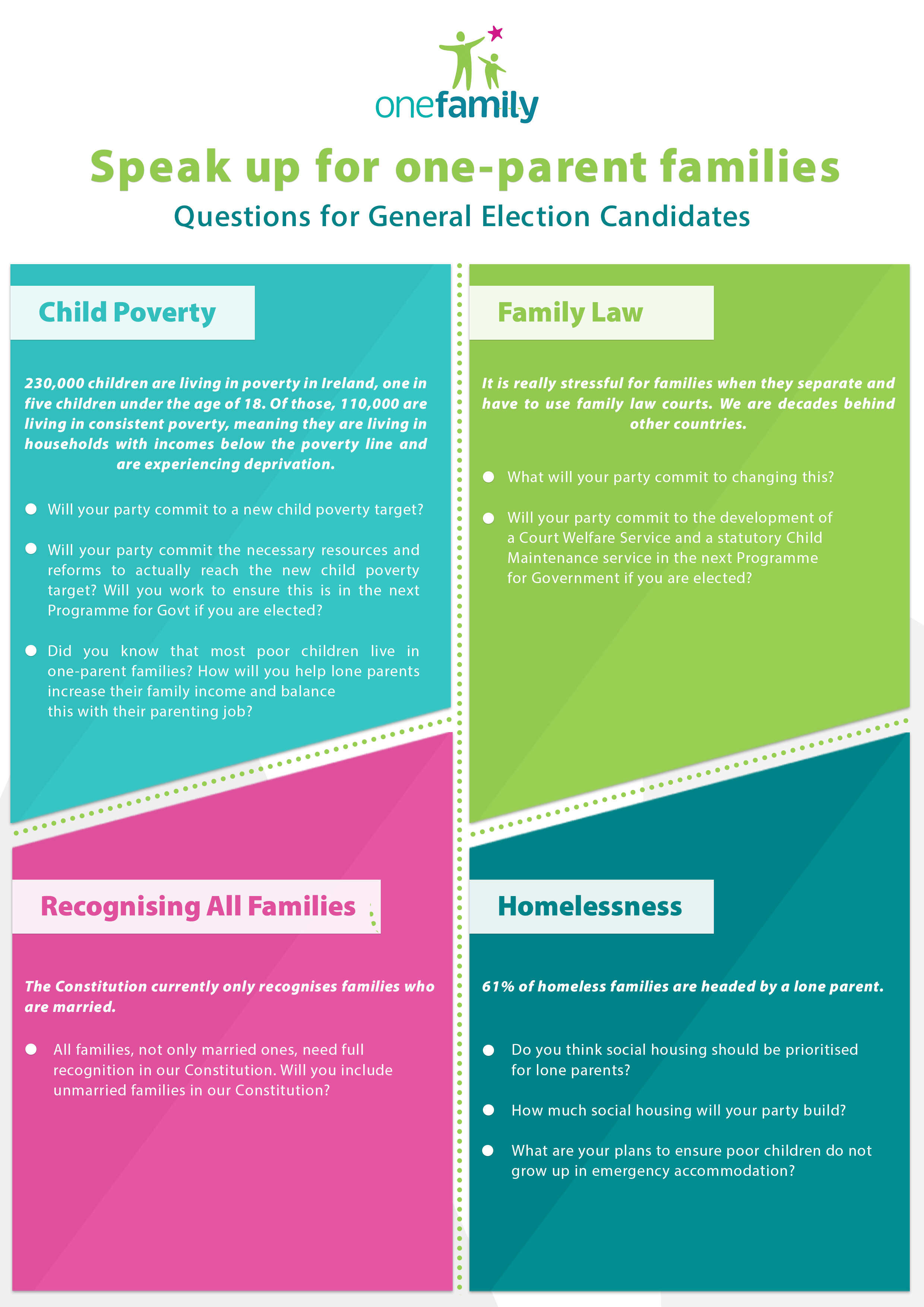
One Family CEO Karen Kiernan said, “Families living in makeshift accommodation and children going without a warm meal shouldn’t happen in Ireland. It’s not who we are. But every night thousands of children and families go without these basic needs, caught in a broken system that pulls them under. It doesn’t have to be this way. Poverty and homelessness are not inevitable. They are symptoms of a broken system.”
One-parent families now make up over a quarter of all families in Ireland. Yet many are struggling to stay afloat against a rising tide of poverty. These families represent a growing and restless force in every constituency in Ireland. They are disproportionately affected by child poverty, homelessness and a family law system that is decades behind our European neighbours. We are asking one-parent families to challenge, in a friendly yet firm manner, election candidates on their plans to address Child Poverty, Homelessness, Reform of Family Law and Constitutional change. Our four top priorities for General Election 2020 are:
- End Child Poverty: Meet and expand on the current target to lift 70,000 children out of poverty by 2020. Develop another target and commit to a strong implementation system with high level political support. Ensure adequate income levels for all families and households through independent benchmarking of income supports.
- End Homelessness: Ireland has a national crisis of homelessness which disproportionately affects one-parent families. Commit to prioritising the building of social housing for families and ensuring that children do not spend longer than six months in emergency accommodation.
- Reform Family Law & Court Welfare Service: Build on family law reforms and commit to developing a comprehensive public Court Welfare Service including a statutory Child Maintenance Service. Ireland is decades behind our European neighbours and must ensure the safety of children and parents in family law proceedings.
- Protect All Families in Ireland: Commit to a referendum to update Article 41.3 of the Constitution to extend rights and protection to all families.
Read our Election Manifesto here:
Ms Kiernan added, “We know the issues that are raised on the doors are fed back to party headquarters and are included in future Programmes for Government so we are asking parents to let their voice be heard. We have put together a list of questions that might help parents to start the conversation with the local candidates so they can make up their own minds on who to vote for.”
/Ends/
Editor’s Note:
One Family was founded in 1972 as Cherish and is Ireland’s national organisation for one-parent families and people sharing parenting or separating, offering support, information and services to all members of all one-parent families, to those sharing parenting, to those experiencing an unplanned pregnancy and to professionals working with one-parent families. Children are at the centre of One Family’s work and the organisation helps all the adults in their lives, including mums, dads, grandparents, step-parents, new partners and other siblings, offering a holistic model of specialist family support services. These services include the lo-call askonefamily national helpline on 1890 66 22 12, counselling, and provision of training courses for parents and for professionals. The askonefamily helpline can be contacted on lo-call 1890 66 22 12.
For further information visit: www.onefamily.ie
Available for Interview
Karen Kiernan, CEO | t: 01 662 9212 or 086 850 9191
Further Information/Scheduling
Noel Sweeney, Communications and Events Manager | t: 01 622 9212 or 085 7241294
One Family’s Election Manifesto 2020
Families living in makeshift accommodation and children going without a warm meal shouldn’t happen in Ireland. It’s not who we are. But every night thousands of children and families go without these basic needs, caught in a broken system that pulls them under. It doesn’t have to be this way. Poverty and homelessness are not inevitable. They are symptoms of a broken system.
One-parent families now make up over a quarter of all families in Ireland. Yet many are struggling to stay afloat against a rising tide of poverty. These families are three and a half times as likely to be at risk of poverty as two-parent households (CSO – SILC 2018). In our Election Manifesto we give our Top Four Election Priorities click here for a copy of the manifesto
- End Child Poverty: Meet and expand on the current target to lift 100,000 children out of poverty by 2020. Develop another target and commit to a strong implementation system with high level political support. Ensure adequate income levels for all families and households through independent benchmarking of income supports.
- Reform Family Law & Court Welfare Service: Build on family law reforms and commit to developing a comprehensive public Court Welfare Service including a statutory Child Maintenance Service. Ireland is decades behind our European neighbours and must ensure the safety of children and parents in family law proceedings.
- Protect All Families in Ireland: Commit to a referendum to update Article 41.3 of the Constitution to extend rights and protection to all families.
- End Homelessness: Ireland has a national crisis of homelessness which disproportionately affects one-parent families. Commit to prioritising the building of social housing for families and ensuring that children do not spend longer than 6 months in emergency accommodation.
We are also asking voters to hold ‘would-be’ politicians to account with a series of questions to test their commitment to these priorities.
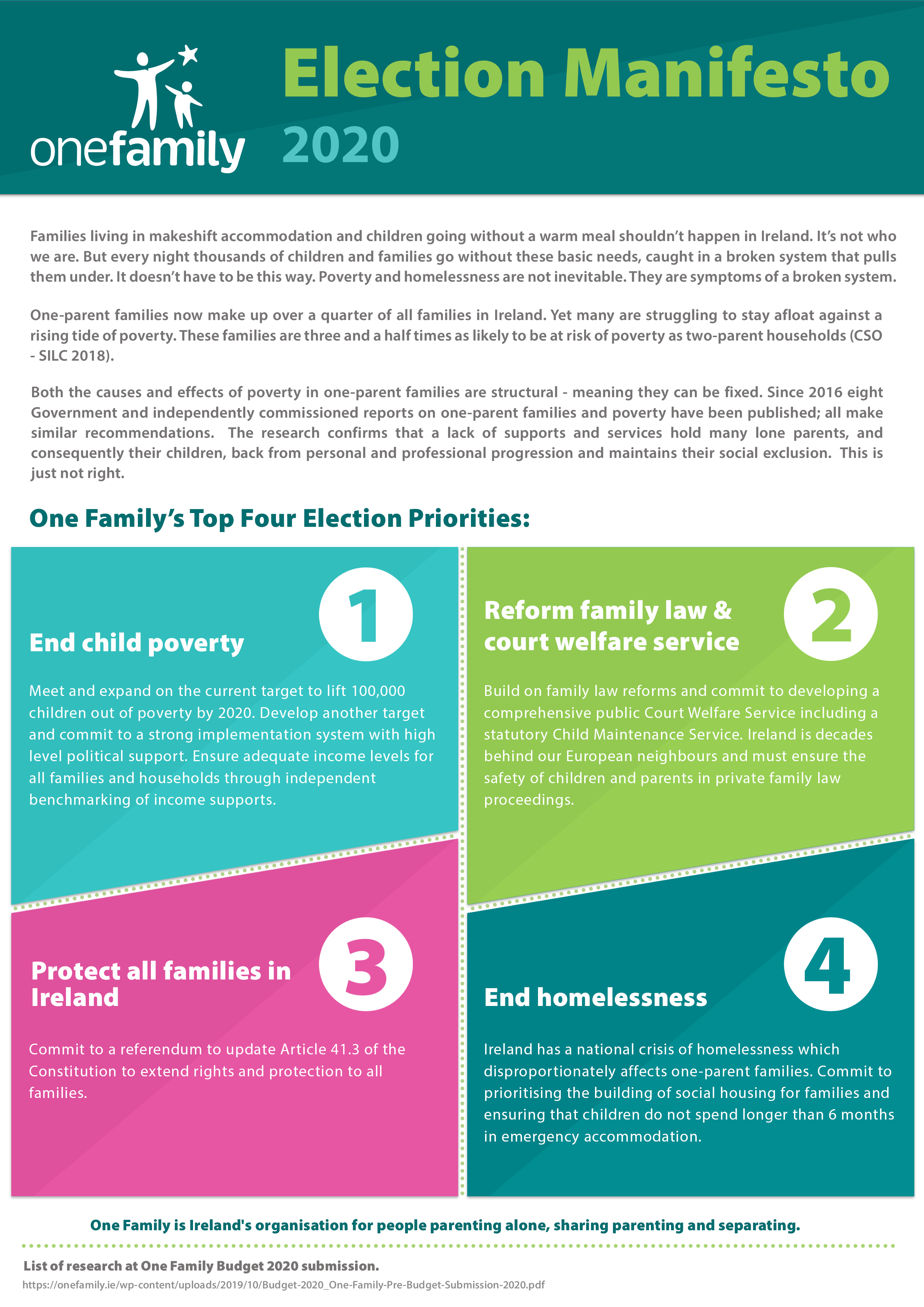
[1] List of research at One Family Budget 2020 submission. https://onefamily.ie/wp-content/uploads/2019/10/Budget-2020_One-Family-Pre-Budget-Submission-2020.pdf
We have a number of new publications available this month including or new ‘Services Brochure’ and ‘Strategy 2019-2021’ booklet please click on images below for more details:
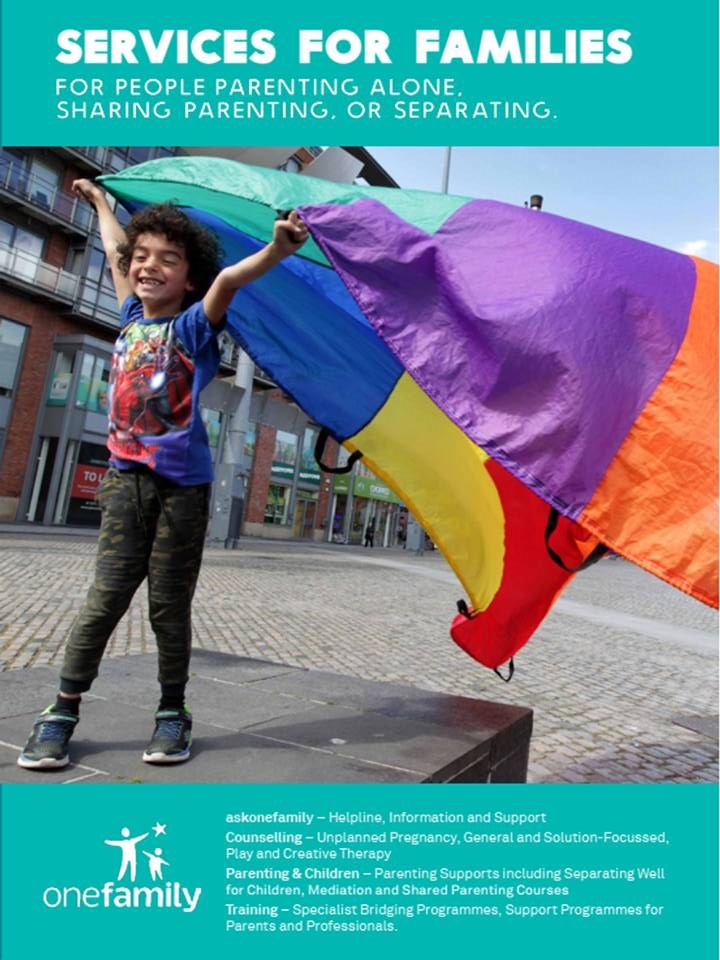
One Family Strategy 2019- 2021: