
Press Release
Children & Family Relationships Bill provides first steps to a modern Family Law system in Ireland –
but One Family warns that family law courts need the resources to do their job properly for all children
(Dublin, Thursday 30 January 2014) One Family – Ireland’s leading organisation for one-parent families in Ireland today welcomes the publication of the Heads of the Children & Family Relationships Bill 2014 by Minister Alan Shatter. As an organisation that has campaigned for over 40 years for legal recognition and support for the wide diversity of families that children live in, we believe this Bill is a good first step that is long overdue.
Karen Kiernan, One Family CEO explains: “This Bill when enacted will provide a higher level of legal security for some of the diverse one-parent families that children live in. We are particularly pleased to see that people who have caring responsibility for children such as step-parents will be able to apply for guardianship, that it will be easier for extended family members such as grandparents to gain contact with their grandchildren and that more non-marital fathers will become guardians automatically of their children.”
However, One Family has some serious concerns about how aspects of the Bill can really be implemented given the serious resource restrictions that exist, and the lack of consistency and specialist knowledge that can characterise some family law proceedings and the requirement to hear children’s voices.
Kiernan continues: “We are very concerned about the lack of family assessments available to judges in family law courts which can be essential when upholding the principle of ‘a child’s best interest’. We have seen that it is extremely difficult to make nuanced and life-changing decisions without full, impartial information on what is going on in a family. A robust court welfare system will need to be put in place that can assess issues such as child protection, domestic violence, parental capacity so that judges can make informed, reasoned decisions. Such a system could also effectively hear the voice of children of all ages. The current Heads indicates that the costs of such reports, counselling, mediation or parenting courses as ordered by court will be borne by the parents involved and this is not realistic for many families.
It is time that a standardised, holistic, family-centred approach is taken to family law in Ireland where the starting point has to be the child and their family rather than the traditions of the legal system. The Bill is well-intentioned but will need an implementation plan with an attached budget to really make a difference.”
Part of what Minister Shatter is working to resolve is in relation to parenting orders and plans that are not adhered to. One Family offers a range of specialist counselling and parenting supports to people going through separation, sharing parenting of their children as well as those who parent alone. One Family also ran the two pilot Child Contact Centres over the past three years in partnership with Barnardos – a service that is now closed due to lack of government funding.
Karen Kiernan further explains: “Whilst much of this Bill is an excellent improvement on what was there, there is a big miss in relation to Child Contact Centres which are not mentioned. They have been proven to be needed and effective in reducing the dangers for children in high conflict families, in ensuring parenting orders work and in supporting families to move on to self-arranged contact. No Government department has been willing to continue funding them and they are not provided for in the Heads of Bill as a necessary service for courts.”
About One Family
One Family was founded in 1972 and is Ireland’s leading organisation for one-parent families offering support, information and services to all members of all one-parent families, to those experiencing an unplanned pregnancy and to those working with one-parent families. Children are at the centre of One Family’s work and the organisation helps all the adults in their lives, including mums, dads, grandparents, step-parents, new partners and other siblings, offering a holistic model of specialist family support services. These services include the lo-call askonefamily national helpline on 1890 622 212, counselling, and provision of training courses for parents and for professionals. One Family also promotes the Family Day Festival, an annual celebration of the diversity of families in Ireland today, with 10,000 people attending in 2013 (www.familyday.ie). For further information, visit www.onefamily.ie.
Available for Interview
Karen Kiernan, CEO | t: 01 662 9212 or 086 850 9191
Further Information/Scheduling
Shirley Chance, Director of Communications | t: 01 662 9212 or 087 414 8511
The future of our families. What policies can do for children in vulnerable situations.
On 28th January 2014, leading experts from research, policy, and NGOs met in Brussels to discuss the most recent evidence on children in vulnerable situations and the potential scope of policy interventions. Stuart Duffin, our Director of Policy and Programmes, was a panelist.
A poor socioeconomic background and family disruptions, such as parent separation, may have an impact on the life-chances of children. But so far, empirical evidence is quite scarce. In two workshops, prominent experts discussed their most recent findings. For example, what role does divorce play for the cognitive abilities and school performance of children? Can institutionalised childcare and public custody compensate disadvantages due to difficult living conditions? Is there a difference between immigrant and native youths? And are there country-specific patterns which policy makers have to take into regard?
The workshops were organised by the Population Europe Secretariat (hosted by the Max Planck Institute for Demographic Research) and FamiliesAndSocieties, in cooperation with Oxford Population Centre | European University Institute | International Federation for Family Development | European Economic and Social Committee.
Stuart Duffin states: ‘‘There is no evidence to suggest that, although increasingly more commonplace, separation is an easy transition for children and parents. Partnership separation is not a single event. It is a complex process that unfolds over time and requires a series of reorganisations and adjustments. How children cope with parental separation is affected by developmental stage, temperament, cognitive capacities, and personal resilience.”
He continues: “Our experience of working with those parenting alone and those sharing parenting demonstrates that many children are resilient and can learn to manage the challenges and stress parental separation creates. Therefore, separation-specific interventions that build and restore competence can reduce reliance on social and legal systems. Preventive interventions that educate and support parents are an important component of successful family transition when they are introduced early in the process. Focused intervention plans, with clearly articulated goals reflecting children’s and families’ unique qualities, are recommended as a means of fostering resilience.”
| Population Europe is the network of 29 leading demographic research centres and 150 eminent researchers in Europe. As a collaborative network it provides comprehensive knowledge, information and insights into fundamental demographic trends and diverging population developments. This expertise is key to understanding the political, social and economic developments of Europe in the 21st century.The Population Europe Event has received funding from the European Union’s Directorate-General for Employment, Social Affairs and Inclusion under grant agreement n° VS/2012/0168 for the project Population Europe 2.0. | FamiliesAndSocieties is the European think-tank in the field of family policy research. It brings together 25 universities and research institutes in 15 European countries and three transnational civil society organisations. It aims to investigate the diversity of family forms, relationships and life courses in Europe, to assess the compatibility of existing policies with these changes and to contribute to evidence-based policy-making.The FamiliesAndSocieties Workshop has received funding from the European Union´s Seventh Framework Programme (FP7/2007-2013) under grant agreement n° 320116 for the research project Families And Societies. |
We invite you to Step Out with One Family and run/walk in the Mini Marathon as part of Team One Family. As Ireland’s leading organisation for people parenting alone and sharing parenting, and in the year of the 20th anniversary of UN International Year of the Family, we need people more than ever to take part with all funds raised contributing directly towards our work with some of the most vulnerable families in Ireland.
Team One Family participants will receive a sponsorship pack which includes:
- a sponsorship card
- a One Family t-shirt
- and information including Race Hints and Training Ideas
Our offices – Cherish House on Lower Pembroke Street – are on the mini marathon route and just a few minutes from the start and end points. Cherish House serve as a hub for our team on the day: a place to enjoy complementary refreshments, to change, store personal items, and chat.
The Flora Women’s Mini Marathon 2014 is 10K in distance and will take place on Bank Holiday Monday, 2nd June 2014 at 2.00pm. All participants must enter either through the official Entry Form which will appear in The Herald on Wednesdays and Saturdays from 19th February and online here.
A convenient way to collect donations from friends/family is through Sponsor.ie, the online fundraising tool that helps you to collect donations for your favourite charities. Sponsor.ie allows you to keep your supporters updated through photos and video and by linking to your existing social networking sites, such as Facebook and Twitter, it’s easy to let everyone know what an amazing thing you’ll be doing.
To set up your own fundraising page click here. To check out One Family’s Sponsor.ie page click here.
For more information, please email Fiona. We look forward to stepping out together!
Let your voice be heard! One Family is seeking willing participants to engage with our Budget 2015 Panel. The Budget Panel will consist of ten lone parents and/or parents sharing parenting who will collaborate with One Family throughout 2014.
Panel members will be encouraged to contribute their own lived experience and personal circumstances in order to enhance and parent proof One Family’s 2015 budget submission. We welcome expressions of interest from parents in a variety of circumstance, such as those in education or employment, in receipt of government supports, never married, separated, divorced etc. Ideally, they will be willing to engage with media and training will be provided. The panelists will work with us to produce a budget submission which reflects the lived reality for lone parents in Ireland.
Persons interested in taking part should:
- Wish to articulate their opinions and be comfortable discussing core budget issues (housing, childcare etc.)
- Currently live in Ireland – we hope to hear from people from both urban and rural areas
- Be able to commit to a minimum of three hours per month (a mixture of phone and online engagement with occasional meetings) on a volunteer basis
Existing One Family Members are encouraged to participate though it is not not essential for a panelist to be a Member.
If you are interested in being a One Family Budget 2015 Panelist, please click here to email Valerie Maher for further information by midday on Friday 24th January 2014.
UPDATE: 31st January 2014 – The Budget Panel is now filled and we look forward to collaborating with its members throughout the year.
Many worried parents are calling our askonefamily lo-call helpline regarding the Single Person Child Carer Credit which has replaced the One-Parent Family Credit from 1st January 2014. The Single Person Child Carer Credit (SPCCC) is different from the One-Parent Family Credit (OPFC) as now it is only available to one parent – the parent with whom the child lives for a majority of the year – whereas previously both parents could each claim the credit for their child.
Revenue refer to the Primary Claimant and the Secondary Claimant; the first being the parent with whom the child lives for either the full year or most of the year and the second being the parent with whom the child spends time and resides for at least 100 days in the year.
The qualifying conditions are:
- That your child is either born in the tax year, is aged under 18 at the start of the tax year or over 18 but in full time education.
- As the claimant you must not be cohabiting or be jointly assessed for tax (either as married or civilly partnered) or be married or civilly partnered (unless separated) or widowed or a surviving civil partner in the year for which you are making the claim.
Who can claim?
- If the parent with whom the child lives most of the time (primary claimant) does not avail of the SPCCC then it can be relinquished by completing the form SPCCC1. This then means the other parent (secondary claimant) can claim it by completing form SPCCC2, as long as they satisfy the criteria, in that the child must live with them for at least 100 days in the year.
- In instances where the court has awarded joint custody then the parent who receives the Child Benefit will receive the SPCCC. If they are not in employment, or they choose to do so, then it can be relinquished and the other parent can claim it instead, as the secondary claimant.
In the event of the primary claimant relinquishing the tax credit and the secondary claimant applying for and being allocated it, then it remains with this person for the full tax year. If the primary claimant then applies for it during the year (if they go into employment) then it will remain with the secondary claimant for the rest of that year but it will then be allocated to the primary claimant for the following tax year.
The Revenue website has a list of Frequently Asked Questions which may help you determine who may qualify for the SPCCC for your family, as well as links to the relevant forms which can be downloaded; click here for more information.
If you have any additional questions or concerns, please contact our askonefamily lo-call helpline on 1890 66 22 12 or by email.
The impact of these changes is likely to be initially most strongly experienced by parents as we reach the end of January as, for many, the first monthly salary of 2014 will be processed at that time. One Family will continue to advocate on this issue. To read our recent press releases concerning it, please click on the clicks below:
Government has hindered not helped One-Parent Families in 2013
Attack on Parents Sharing Parenting After Separation is Unjust, Unfair and Underhand
More attacks on working mothers and shared parenting; Budget 2014 is anti-family and anti-parent
One Family is one of twenty experts and stakeholders from across Europe contributing to Families and Societies, a large-scale integrating project on the factors that define and shape what families will look like in the future, coordinated through Stockholm University. The projects runs until 31 January 2017. Questions being addressed include: Are existing social and family policies compatible with changes in family patterns?
The main objectives of the project are:
- To investigate the diversity of family forms, relationships, and life courses in Europe.
- To assess the compatibility of existing policies with family changes.
- To contribute to evidence-based policy-making.
The overall conceptual framework is based on three key premises:
- Family life courses are becoming more diverse.
- The interdependency of lives matters.
- Social contexts and policies matter.
“A one hour documentary that tells the story of brave single mothers who took on the government.”
Cherish All The Children is the remarkable story of One Family’s founders; those brave women who refused to give up their children for adoption 40 years ago. They formed Cherish, changed the law on illegitimacy and fought to get a single parent’s allowance.
Cherish was set up by single parents, for single parents and the documentary features interviews with our core founders Maura O’Dea Richards, Margaret Murphy, Evelyn Forde and Annette Hunter Evans who share their personal experiences and the challenges of being pregnant and single in Ireland four decades ago. It also features first President of Cherish, Mary Robinson, and Nuala Feric and Anna Lee, first staff members; with other contributors including CEO of One Family Karen Kiernan and Director of Policy, Stuart Duffin.
Cherish/One Family has brought about massive social and legal change for both parents and children since its foundation in a time when unmarried mothers were encouraged to give their ‘illegitimate’ babies up for adoption and to ‘mend their ways’; a time when contraception was unavailable and abortion unmentionable.
Cherish All The Children explores how Cherish was responsible for changing the law on illegitimacy and the abolition of that term, and for successfully campaigning for the introduction of a Single Parent’s Allowance.
The documentary was first broadcast on Today FM on Sunday 29 December 2013 at 9am. You can listen to it online here.
Contributors:
- Mary Robinson: first President of Cherish
- Maura O’Dea Richards, Margaret Murphy, Evelyn Forde, Annette Hunter Evans: founder members of Cherish
- Nuala Feric and Anna Lee: first staff members of Cherish
- Minister Frances Fitzgerald
- Fintan O’Toole: Irish Times journalist and social commentator
- Karen Kiernan, CEO One Family (formerly Cherish)
- Stuart Duffin, Director Policy & Programmes One Family (formerly Cherish)
Credits:
- Producer/ Presenter: Hilary Fennell
- Editor: Daragh Dukes
- Funded by the Broadcasting Authority of Ireland with the Television Licence Fee
2014 is the 20th anniversary of the United Nations International Year of the Family. One Family has been working to mark this anniversary and marks the UN International Day of the Family every year here in Ireland.
One Family has signed up to the Declaration of the Civil Society on the occasion of the 20th Anniversary of the International Year of the Family.
We have developed links in relation to this anniversary and attended the Doha International Institute for Family Studies and Development (DIIFSD), The International Federation for Family Development (IFFD) and the Committee of the Regions of the European Union in cooperation with the Focal Point on the Family (UNDESA) European Expert Group Meeting ‘Confronting family poverty and social exclusion; ensuring work-family balance; advancing social integration and intergenerational solidarity’ as preparations for and observance of the twentieth anniversary of the International Year of the Family in 2014, in Europe.
We also founded a campaigning coalition called All Families Matter and we are seeking a progressive review of the Constitution in relation to the family.
Proposed activities to mark 2014 as the 20th Anniversary of the UN International Year of the Family
We are calling on the Government to designate a national Family Day.
15 May is the annual UN International Day of the Family and One Family requests that Minister Fitzgerald designates the nearest Sunday as a national Family Day in Ireland. In much the same way as we mark Mother’s Day and Father’s Day, we would like Family Day to also be celebrated. Our annual Family Day Festival will be held on 18 May 2014 again in the Iveagh Gardens and we will be again promoting our call to ‘Celebrate your family – Celebrate all families’ through all the schools, community and voluntary groups in Ireland.
We believe that this cost-neutral designation will send a powerful message to all families that this country respects and celebrates the reality of their lives through this national Family Day.
We are seeking support to hold a seminar to mark a number of significant reforms in relation to family life in Ireland. In a relatively short space of time the legal and social landscape in relation to families will change. Reforms that we are aware of include:
– The establishment of the Child & Family Agency
– Reform of the Family Law Courts
– Introduction of the Child & Family Relationships Bill
– Commitment to a referendum on marriage equality in 2015
– Social welfare reforms impacting on childcare, parenting responsibilities and family life.
2014 may provide an opportune time to reflect on these changes and to work towards a Constitutional reform of the definition of family which will inevitably be required at some stage. A conference or seminar will provide a forum for people to learn more about reforms and to look forward to a new vision of how our laws and policies can reflect the reality of the diversity of family life in Ireland today.
One Family also plans to highlight the year with a number of other smaller events which will be kicked off by a radio documentary on the founding of our organisation over 40 years ago which will be aired at 9am on Sunday 29 December on Today FM.
Press Release
New Report Proves Marriage is not Responsible for Children’s Well-being
(Dublin, Friday 20 December 2013) One Family, Ireland’s leading organisation for one-parent families, welcomes the launch today of the report ‘Growing Up in a One-Parent Family’, a study by researchers at the University of Limerick using the ‘Growing Up in Ireland’ data, published by the Family Support Agency.
A key finding of the study indicates that children from one-parent families and cohabiting families fare the same as children from married families when faced with similarly difficult conditions growing up. This is most detailed statistical study to date of the effects of family structure on child development, and concludes that the traditionally perceived benefits of marriage in relation to child development are not a result of marriage itself but of the parent or parents’ background.
Karen Kiernan, CEO of One Family, states: “This study confirms what One Family has known for years, based on our 41 years of experience working with one-parent families and our evidence-based knowledge, that it is not the legal structure of a family that is important to a child’s well-being but the substance of the family and the relationships within it. However, lone parents in Ireland continue to experience the highest rates of poverty and it is impoverishment that is proven to adversely affect a child’s future. We will continue in our vital work towards ending disadvantage for lone parents and their children.”
While the report also found that, despite controlling for school context and a variety of background factors, children from never-married one-parent families and cohabiting families did less well in their educational performance, it states that they are also more likely to be attending a disadvantaged – DEIS – school. Education and progression opportunities for parents are a core part of One Family’s work towards breaking the cycle of disadvantage.
The report ‘Growing Up in a One-Parent Family:The Influence of Family Structure on Child Outcomes’ is available to read/download here.
Notes for Editors:
- 1 in 4 families with children in Ireland is a one-parent family
- Over half a million people live in one-parent families in Ireland
- Almost 1 in 5 children (18.3%) live in a one-parent family (Census 2011)
- There are over 215,000 one-parent families in Ireland today (25.8% of all families with children; Census 2011)
- 87,586 of those are currently receiving the One-Parent Family Payment
- Those living in lone parent households continue to experience the highest rates of deprivation with almost 56% of individuals from these households experiencing one or more forms of deprivation (EU-SILC 2011)
About One Family
One Family was founded in 1972 and is Ireland’s leading organisation for one-parent families offering support, information and services to all members of all one-parent families, to those experiencing an unplanned pregnancy and to those working with one-parent families. Children are at the centre of One Family’s work and the organisation helps all the adults in their lives, including mums, dads, grandparents, step-parents, new partners and other siblings, offering a holistic model of specialist family support services. These services include the lo-call askonefamily national helpline on 1890 622 212, counselling, and provision of training courses for parents and for professionals. One Family also promotes Family Day, an annual celebration of the diversity of families in Ireland today, with 10,000 people attending events this year on 19 May (www.familyday.ie). For further information, visit www.onefamily.ie.
Available for Interview
Karen Kiernan, CEO | t: 01 662 9212 or 086 850 9191
Further Information/Scheduling
Shirley Chance, Director of Communications | t: 01 662 9212 or 087 414 8511
The Convention on the Constitution has just announced that it has chosen Dáil Reform and Economic, Social and Cultural rights for discussion at their final two meetings in February 2014. It is noted that the Family is included as one of the other prominent topics throughout the process and that “it is likely that the Convention members will take the opportunity to make a recommendation early next year on how these issues might be addressed in the future.”
While we are disappointed at today’s announcement, we look forward to engaging with the Convention in the future.
You can read the Convention press release here.
For further information on the campaign All Families Matter, which calls for a review of the Family in our Constitution.
One Family has advocated for the Childcare Education and Training Support (CETS) Programme to be expanded to include CE Participants as the lack of access to affordable childcare is a barrier to participation for parents with young children, particularly lone parents. We are pleased to have received notification that it is being expanded from 1 January 2014 to include CE Participants.
Access to the CETS Programme for CE participants will mean participants can access childcare for the first time in the same way as participants pursuing FAS/VEC training courses.
An Information Leaflet for individuals wishing to avail of this scheme can be read/downloaded here: CETS Leaflet.
The Afterschool Childcare Scheme will also remain available in 2014. The Department has told us that it “is currently reviewing the criteria for this scheme based on the experience of the pilot with a view to ensuring that the scheme provides support at the most valuable point in time for our customers.” We will issue any updates as received.
Press Release
Government has hindered not helped
One-Parent Families in 2013
(Dublin, Tuesday 10 December 2013) One Family, Ireland’s leading organisation for one-parent families, campaigned for 10 Solutions. No Cuts. in the lead up to Budget 2014. These ten solutions are practical and economic measures that would greatly improve the quality of the lives of the adults and children of one-parent families in Ireland today. The campaign, a response to the harsh cuts of Budget 2012 that impacted disastrously on so many lone parents, was strongly supported by members of the public with hundreds of emails sent to TDs around the country.
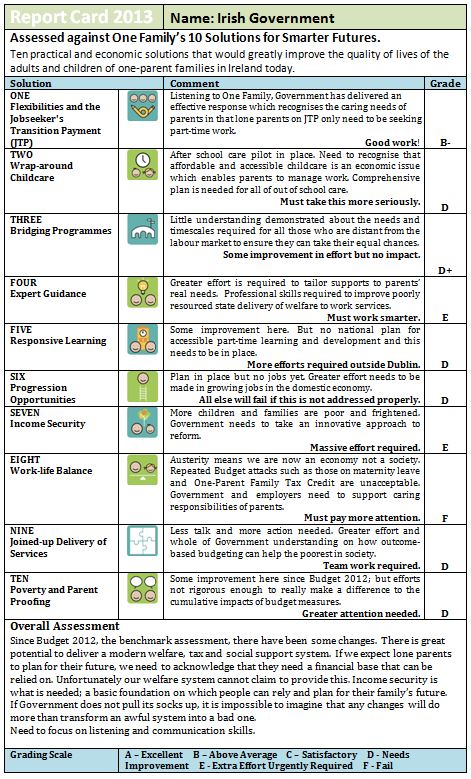
So has Budget 2014 helped Ireland’s poorest families and children, and enabled lone parents to get back to work? One Family analysed the success or failure of Government to achieve each of its proposed 10 Solutions for Smarter Futures and awarded a score to each. The ‘Report Card’ below shows some small improvements but a very disappointing overall assessment with greater effort needed in most areas.
Karen Kiernan, CEO of One Family, states: “Following the dire cuts unleashed on one-parent families in Budget 2012, One Family has been providing solutions to government on how to help meet its own policy objectives of getting lone parents into sustainable employment. Government has followed some of what we have advised but it has a long way to go. There is deep and continuing dissatisfaction with the existing social assistance system from all quarters: community groups, business, politicians, the people who run the system and customers.”
Stuart Duffin, One Family’s Director of Policy, comments: “Budget 2014 needed to deliver opportunities and chances for all our families and in particular those parenting alone. As Enda Kenny says, ‘Work must pay’; but more importantly investment is needed to help families out of persistent poverty. Investment in resources and services will enable that move. If ‘work is to pay’ we need to look at how an efficient tax system can enable change; for example, Child and After School tax credits, moving FIS to being paid through the pay packet and on a sliding scale.”
Mr Duffin continues: “Budget 2014, despite being an opportunity to reward achievement, has in many ways – such as the ongoing slashing of the earning disregards and the abolition of the in-work One-Parent Family Tax Credit for both caring parents – nurtured perverse economic incentives to engage in the labour market. The integration of social and economic instruments should be a whole of government effort, to prevent unintended consequences.”
One Family’s assessment:
Notes for Editors:
- 1 in 4 families with children in Ireland is a one-parent family
- Over half a million people live in one-parent families in Ireland
- Almost 1 in 5 children (18.3%) live in a one-parent family (Census 2011)
- There are over 215,000 one-parent families in Ireland today (25.8% of all families with children; Census 2011)
- 87,586 of those are currently receiving the One-Parent Family Payment
- Those living in lone parent households continue to experience the highest rates of deprivation with almost 56% of individuals from these households experiencing one or more forms of deprivation (EU-SILC 2011)
For further information, visit www.onefamily.ie.
Available for Interview
Karen Kiernan, CEO | t: 01 662 9212 or 086 850 9191
Stuart Duffin, Director of Policy & Programmes | t: 01 662 9212 or 087 062 2023
Further Information/Scheduling
Shirley Chance, Director of Communications | t: 01 662 9212 or 087 414 8511
Later this week, the Department of Social Protection will be issuing letters to affected One-Parent Family Payment (OFP) recipients informing them that, from 1 January 2014, the OFP scheme’s income disregard will be reduced from its current amount of €110 per week to €90 per week for the duration of 2014.
In Budget 2012, it was announced that there would be a gradual reduction in the amount of earnings from employment that would be ignored (disregarded) when calculating the rate of OFP paid and that this change would come in over a number of years.
In 2012 the amount ignored was €130; in 2013 it is €110; in 2014 it will be €90; and it will decrease further to €75 in 2015 and €60 in 2016.
From 1 January 2014, you can have earnings of €90 without it affecting the rate of payment of OFP and so if your earnings are greater than €90 per week, then your rate of OFP will be changed to take this new rate into account.
It is important to note that if there has been any change in your circumstances which may affect your entitlement to One-Parent Family Payment, including a change in your weekly earnings, then you should notify your local social welfare office so that a review of your entitlement can be carried out, and if you have moved recently and not informed them of your new address yet, it is important to do so.
How might this change affect you? We have included a Q&A below based on commonly occurring situations.
askonefamily Questions:
Q. I have a letter to say that my One-Parent Family Payment will change in 2014 because I am working and earning €150 a week. Do I have to do anything?
A. No, the adjustment to your rate of payment will happen automatically; however if there are any changes in your circumstance such as a change of income then you should contact your local social welfare office to let them know of this.
Q. I earn €110 a week at the moment and still get the full payment for myself and my daughter. Does this change mean I will lose some of my payment next year?
A. Yes, the reduction from €110 to €90 means that you will now be means-tested as having €10 a week. You are only means tested on half of the difference, so for your earnings of €110 as the disregard will be €90 this leave €20 in the difference and you will then be means tested on half of this, which is €10 per week. This will mean a small reduction in your One Parent Family Payment. If your earnings from work are your only additional income you would expect to see a reduction in payment of €2.50 a week.
Q. I am working part time and earning €120 a week. Up until now this has been my only income apart from One-Parent Family Payment but my son’s Dad has got a job and is now going to be paying maintenance of €30 a week. What should I do?
A. As your income will increase once you start receiving maintenance because this is a change in your circumstances, you will need to let your local social welfare office know. Up to the first €95.23 of maintenance maybe disregarded if you have rent or housing costs.
If you would like any additional information about how your circumstances may be affected, please call our askonefamily national helpline on lo-call 1890 662 212 or email support@onefamily.ie.
An economic report revealing that the cost of childcare in Ireland is creating a barrier for parents who want to return to work, commissioned by the Donegal County Childcare Committee and conducted by Indecon International Economic Consultancy Group, was launched today by Minister for Children and Youth Affairs Frances Fitzgerald. The independent nationwide report, entitled Supporting Working Families – Releasing a Brake on Economic Growth, examines potential policy options to address the childcare obstacles that exist as a barrier to employment.
Key findings include:
- Annual Cost of Fulltime Childcare for Two-Child Family is €16,500
- Barriers to employment as a result of childcare costs are severe among lower income groups, with 56% prevented from looking for a job
- 26% of parents were prevented from returning to work or training because of childcare arrangements
- Ireland has second highest childcare costs in OECD as a percentage of average wages
One Family attended the launch today with our Director of Policy & Programmes, Stuart Duffin, responding:
“Finally a report that asserts childcare is a fundamental of economic policy and a service which underpins community economic development and growth. Access to quality childcare has major impacts on child poverty and on families’ quality of life more generally. We need to aim to encourage debate about the correct level of support childcare and how it is funded through a whole of government social investment.”
Government is charged to commit to protecting childcare spaces in both the short and long term, for families in transition and particularly for those parenting alone. For low-income parents, lack of access to quality and affordable childcare is a fundamental challenge to participation in the labour market[i]. Any loss of funding puts at risk the availability of community based care for children where families need it. Consequently, parents’ ability to work is jeopardised which subsequently makes vulnerable the entire childcare system and ultimately the economy as a whole. In the short term, enabling investment through tax credits and incentives must be committed to providing mechanisms and means to keep crèches intact. In the longer term, we must work together to secure the integrity and sustainability of the childcare system.
A clear pathway needs to be agreed on how to go to a tax based system from the current arrangement of FIS CETS and CCS as we see hard pressed working families struggling with childcare cost. Therefore we need to support access to good quality childcare through in-work supports. Currently, the danger is that the employment subsidy part of FIS (the income disregard) acts as a perverse incentive for lone parents and makes the cost of childcare unreachable.
Lone parents transitioning from social assistance to waged work should not be penalised and should gain financial benefit from this move. The “work incentives” currently in place as well as the continuing erosion of income disregards do not support parents entering the labour market[ii].
Government must initiate and commit to supports for low-income families to ensure they receive (tax) credits and assistance aimed at improving incomes, for example the Family Income Supplement. In-work assistance initiatives and supports improve the incomes of low-income families (and in particular those parenting alone). They are vital tools in engineering financial independence and mitigate the impact of increasing costs of taking up employment. Government must ensure that it pays to work: the cornerstone of the Government’s welfare to work strategy and future practice.
Currently, the tax and benefit system is unfair and traps people in poverty and unemployment. It is not possible to reform the system as it currently stands. It may be possible to reduce some of the worst aspects by tinkering with starting rates of tax and benefit tapers, but the inherent inequality in the way that tax-payers and benefits recipients are treated will remain. Policy-makers and politicians must take this opportunity to consider a total reconfiguring of the tax and benefits system. Without this, it is impossible to imagine that any changes will do more than transform an awful system into a bad one.
[i] EuroChild, (2012), Overall assessment of the SPC advisory report to the EC on “Tackling and preventing child poverty, promoting child well-being” & suggestions for future actions
[ii] ESRI,(2012), Budget Perspectives, Tax, Welfare and Work Incentives
The Human Rights Week 2013 website acknowledges UN Human Rights Day on Tuesday 10 December which every year celebrates human rights, highlights a specific issue, and advocates for the full enjoyment of all human rights by everyone everywhere. In 2013, the spotlight is on the 20th anniversary of the establishment of the UN Office of the High Commissioner for Human Rights, under the slogan ’20 years working for your rights’. The international day generates many events in the days before and after 10 December leading to a de facto ‘Human Rights Week’.
FLAC (Free Legal Advice Centres) has created this pop-up site to gather together a selection of these events taking place around the country. It can be visited here.
“The Constitution that governs our country was published back in 1937 and Irish family and social life has changed radically since then. Unfortunately the Constitution has not changed in tandem with this and is now woefully out-of-step with the reality of life for many children and families in Ireland because it doesn’t recognise them as families,” writes One Family’s CEO Karen Kiernan in today’s TheJournal.ie.
Karen discusses All Families Matter, the campaigning coalition calling for a review of the Family in our Constitution, and outlines the reasons a Constitutional review of the family is needed. Anyone can make an online submission to the Convention this week. Members of the Convention will decide by online poll within the next week what new areas they will look at in February at their final scheduled meeting. It is still possible to lobby political members, make online submissions or attend the last regional meeting today, Wednesday 27 November, in Limerick to ask them to review the family.
Read the column in TheJournal.ie here.
Click here to find out more about All Families Matter and how to make an online submission.
The heads of the Children and Family Relationships Bill are likely to be published next month by Minister for Justice Alan Shatter. The Children and Family Relationships Bill 2013 is intended to create a legal structure to underpin diverse parenting situations and provide legal clarity on parental rights and duties in diverse family forms. We have summarised ten points of interest from the Bill below:
- The Bill is a legal framework for family law issues such as guardianship, custody, access and the raising of children in the diverse family forms that are part of today’s society. These families may be made up of married families, co-habiting and civilly partnered couples as well as extended family members, such as grandparents, who may be caring for children. It also reflects the recent provision made in the Children’s Referendum in 2012 for constitutional change
- There is a need for improved supports for the courts in matters of family law and childcare cases in order to ensure that orders, made in the best interests of children, are complied with.
- It is intended to increase the number of non-marital fathers who are automatically legal guardians by providing that a non-marital father is a guardian of his child if he has been co-habiting with the child’s mother for at least a year before the child’s birth, and in situations where the cohabitation ends less than 10 months before the birth (if the relationship ends)
- It is intended that others in a parenting role with the child may apply for guardianship, be they civil partners, step-parents, those living with the biological or adoptive parents as well as those acting in loco parentis for a time. This is in instances where the child does not have more than two guardians.
- It is intended to establish that the best interests of the child is paramount in considering decisions on custody, access and guardianship.
- It is intended that provisions will be put in place to support parenting with penalties for parents who do not meet access or maintenance orders
- Guidance will be given to the court as to what constitutes the best interest of the child, including needs and views of the child, history of upbringing and care as well as having regard to any family/domestic violence and its impact on the safety of the child and other family members.
- Access will be simplified, removing the two stage process that currently exists for a person other than a parent seeking access to a child.
- Children aged over 12 must be consulted in relation to applications for guardianship, custody and access
- There are also proposals to look at making parent-related orders work, when a parent or guardian does not comply with court orders on custody or access to the child.
For further information on the Bill, take a look at the following link to the Department of Justice website:
The Children and Family Relationships Bill 2013
We are delighted to announce that a percentage from the sale of every Santy bagel at Itsa outlets will be donated towards the work of One Family.
The Santy bagel is an onion bagel with roast turkey breast, baked ham, homemade herb stuffing, cranberry sauce, lettuce, mayo and butter and it’s in Itsa now. You can find Itsa stores at Dún Laoghaire, Arnotts, Sandymount, Malahide, Hugh Lane Gallery, IMMA, Sandyford, Exchequer Street, Dublin Castle, Ranelagh and Harvey Nichols Dundrum.
Thank you Itsa and thank you to everyone who buys a Santy bagel in the weeks ahead for your support. Enjoy.

Press Release
One Family, Ireland’s leading organisation for one-parent families, reacted to the announcement of the abolition of One Parent Family tax credit with concern following the Budget 2014 announcement. Today this concern has been cemented with evidence of the government’s inability to practically and holistically respond to what One Family and hundreds of parents have been communicating since the shock announcement.
One Family wrote to every TD and publicised information based on over 40 years of experience including direct feedback based on what hundreds of parents told us following the announcement about the damaging consequences for separated Fathers and Mothers who share parenting of their children.
Karen Kiernan, CEO of One Family, comments: “One Family warned the government that merely making the Single Parent Child Carer credit available to one or other separated parent will cause huge problems and we predict that there will be heavier court use, family conflict and use of the Legal Aid Board as a result. What will happen when the resident parent moves into employment and also requires this tax credit? How will it be decided who gets it? Can it be shared? Either way it continues to be an additional tax on one-parent families who were hit brutally in Budget 2012 and who are continuing to feel these effects year on year.”
Stuart Duffin, Director of Policy and Programmes at One Family states: “The removal of an in-work tax credit from parents who are negotiating the difficult job of sharing parenting is highly disappointing. The hundreds of parents who have contacted us will be very disappointed and all to save a small amount of money to the exchequer.”
The One Parent Family tax credit of €1,650 was previously available to both working parents sharing parenting after separation. It will be replaced by a Single Person’s Child Carer tax credit of €1,650 which will now be available first to the parent in receipt of Child Benefit and if not being used by them will be available to the other parent, from January 2014. Some parents may be at a loss of over €125 per month as a result of the removal of the one-parent family tax credit and the removal of the one-parent family tax rate.
In acknowledgement that reform is needed, One Family had proposed that a Child Support & Parenting Agreement – a written agreement between separated parents on the amount of child maintenance to be paid towards the financial costs of raising their children including an agreed plan in relation to parenting issues as appropriate with be in place between the parents – be submitted when applying for the tax credit. This would help to ensure that separated parents engaged in appropriate shared parenting arrangements would be able to avail of the Tax Credit and/or allocate the credit between them.
One Family regrets that government has not listened to separated parents sharing parenting responsibly and has not accounted for the long-term outcomes of this mistaken reform which will result in increased risk of poverty for many of the fathers, mothers and children already at the highest risk of deprivation in the state today.
Concerned parents can contact the lo-call askonefamily helpline on 1890 662 9212 and email support@onefamily.ie.
Dearbhla * wrote to One Family about the Budget 2014 announcement of the abolition of the One Parent Family Tax Credit.
Dearbhla (39) is a separated wife whose marriage broke down in 2005 after twelve years. She and her husband (49) agreed to separate on good terms and always put their son (now aged 13) first, and continue to do so. Dearbhla’s ex-husband has always voluntarily paid maintenance to support his son and they still have a mortgage on the family home.
In her own words:
“My ex-husband has a full time job and he works hard. I work part-time. I felt sick to the pit of my stomach when I listened to the budget and realised what the removal of the One Parent Family Tax Credit would do to us. My ex-husband is ill and is suffering from stress from work/financial pressure. He has said several times recently that he believes we would be better off financially if he was no longer here. His father died at sixty years of age due to a stroke, and the doctor has warned him he is heading the same way if he does not stop worrying and get his stress under control. I am genuinely concerned this will push him over the edge.
After maintenance he has to pay for rent, electricity, gas, food, etc. I have the mortgage, electricity, gas, food, school costs etc. At the moment he has no TV licence as he can’t get the money together to pay for it. He dresses himself from charity shops. This is a man who is working a full week’s work to end up with so little.
I am not in arrears in my mortgage as the one thing I fear more than anything is losing the home I have made for myself and my son. I will go without food etc. to ensure my son is fed and well looked after, and my bills are paid. We do not drink or smoke, and as for socialising, I cannot remember the last time I went out. The last holiday I had was in 2004.
We have nothing left to give.
When I say nothing, I mean nothing. I am pleading with the government to not let this huge cut to our family go through and to try to understand the extra costs a separated couple endures. We are simply honest, decent people who have always tried to do the right thing.”
One Family is extremely concerned by the Budget 2014 announcement of the replacement of the One Parent Family Tax Credit with a Single Person Child Carer Tax Credit. To read more and to download a pro-forma letter that you can adapt to send to your TDs about this issue, please click here.
The group Irish Parents for Equality are calling for signatures to a petition which can be found here.
* No details have been changed apart from the name of the mother
One Family is extremely concerned by the Budget 2014 announcement of the replacement of the One Parent Family Tax Credit with a Single Person Child Carer Tax Credit as it causes a significant number of problems and possibly unintended outcomes.
The financial impact of abolition of the One Parent Tax Credit for the non-resident parent, as verified by Revenue, is:
| Annual wage | Difference in tax take per week |
| €13,500 (minimum wage x 30 hours) | No change |
| €20,000 | €13 |
| €30,000 | €10 |
| €40,000 | €48 |
| €60,000 | €47 |
The Revenue Commissioners estimates that for 2013, 76,800 income earners utilise some or all of the One-Parent Family Tax Credit. The gender breakdown is estimated as follows:
Female 51,224
Male 25,573
Total: 76,797
One Family has written to all Ministers, TDs and Senators to voice these concerns and urges everyone to write to their Representatives as soon as possible to do the same.
A proforma letter with suggested text that individuals can change as required is available to download here: One Parent Family Tax Credit_Letter to Representatives
A list of TDs and Senators including their contact details is available here.
One Family representatives have also participated in a number of press, radio and television interviews on the issue. You can read the press releases issued by One Family below:
17.10.2013 | Attack on Parents Sharing Parenting After Separation is Unjust, Unfair and Underhand
15.10.2013 | Budget 2014 is Anti-family and Anti-parent
Press Release
Attack on Parents Sharing Parenting After Separation
is Unjust, Unfair and Underhand
(Dublin, Thursday 17 October 2013) One Family, Ireland’s leading organisation for one-parent families, is deeply concerned by the removal of the One Parent Family tax credit and tax free allowance announced on Tuesday as part of Budget 2014 which will have disastrous and far-reaching consequences for separated Fathers and Mothers who share parenting of their children.
Stuart Duffin, Director of Policy and Programmes at One Family states: “Claimants of the One Parent Family tax credit are working Mums and Dads who are committed, responsible parents participating in a successful arrangement with their child’s other parent for the well-being of their child. This is an in-work support and the kind of mechanism that needs to be in place to deliver Pathways to Work, a cornerstone initiative of the Government’s recovery programme. Ultimately it is children who will be impacted with less money to go round in already hard hit families.”
The One Parent Family tax credit of €1,650 was previously available to both working parents sharing parenting after separation. From 2014, it is being replaced by a Single Person’s Child Carer tax credit of €1,650 which will only be available to the parent in receipt of Child Benefit. As the principle carer is usually the child’s Mother, and she may not be working, these changes mean that in many cases neither parent will now meet the specified criteria. Some parents may be at a loss of over €125 per month as a result of the removal of the one-parent family tax credit and the removal of the one-parent family tax rate.
Duffin continued: “One Family has a received a barrage of calls to the askonefamily helpline, plus emails and Facebook comments from worried parents who are already pushed to their limits. There is a lack of joined up thinking and policy between the Departments of Finance, Social Protection and Children & Youth Affairs as this government is penalising the good practice of shared parenting. One Family is actively calling for clarity and action to ensure that working parents don’t become welfare recipients.”
One Family warns Government that it must address implementation problems, otherwise this is going to create long-term challenges for parents.
Karen Kiernan, CEO of One Family, comments: “We are calling on Government to reverse this decision and to reinstate the relevant tax credits to ensure that one-parent families who are still coping with the cuts of Budget 2012 are not pushed further into poverty. We are concerned that along with other government measures this will damage the objective of making work pay and more people will end up becoming customers of the Department of Social Protection as many fathers have told us they simply won’t be able to pay as much maintenance as they have been.”
Concerned parents can contact the lo-call askonefamily helpline on 1890 662 9212 and email support@onefamily.ie.
Notes for Editors:
- 1 in 4 families with children in Ireland is a one-parent family
- Over half a million people live in one-parent families in Ireland
- Almost 1 in 5 children (18.3%) live in a one-parent family (Census 2011)
- There are over 215,000 one-parent families in Ireland today (25.8% of all families with children; Census 2011)
- 87,586 of those are currently receiving the One-Parent Family Payment
- Those living in lone parent households continue to experience the highest rates of deprivation with almost 56% of individuals from these households experiencing one or more forms of deprivation (EU-SILC 2011)
- Operational Challenges for Government to be addressed:
- If the principal carer is not working, can the allowance be claimed by the other parent?
- If the principal carer is not working and the allowance is claimed by the other parent, what happens when the principal carer returns to work?
- What about parents who share care 50/50?
- How will this be managed for parents who are already in dispute with each other following separation?
- Can clear provisions be made for flexibilities such as splitting the credit between working parents; and making it available to the working parent, usually the Father, who is often classed as ‘secondary carer’.
Available for Interview
Stuart Duffin, Director of Policy & Programmes | t: 01 662 9212 or 087 062 2023
Karen Kiernan, CEO | t: 01 662 9212 or 086 850 9191
For Case Studies, Further Information/Scheduling
Shirley Chance, Director of Communications | t: 01 662 9212 or 087 414 8511
One Family has summarised the announcements of Budget 2014 in relation to a number of areas of relevance to people parenting alone or sharing parenting.
Budget 2014People parenting alone and sharing parenting |
||
Changes to Social Welfare payments for 2014 |
||
| Basic rate of payment | The weekly rate of payment is staying the same in 2014 for all weekly social welfare payments for those of working age and pensioners. | No change. |
| One Parent Family Payment | There will be no change to the rate of payment in 2014.
For those in employment the new rate of income disregard of €90 a week will be introduced in 2014, reduced from €110 in 2013. This means that the first €90 of earnings will be ignored and half of the remainder of earnings will be assessed to give a new rate of One Parent Family Payment. |
No change.
Income Disregard reduced. |
| Child Benefit | The rate remains at €130 and this will be for each child, as announced in December 2012. | No change. |
| Maternity Benefit | The rate of payment will be standardised at €230 for new claimants; this is a change from a maximum payment of €262 and a minimum of €217.80. The change will come into effect from January 2014. | Payment standardised. |
| Fuel Allowance | Rate of payment will remain and there is no reduction in the number of weeks. | No change. |
Secondary Payments |
||
| Back to School Clothing and Footwear Allowance | Unchanged for all children under 18. In 2014 it will be paid for those aged 18 and over in secondary school but not for those in third level education. | No longer payable to children in third level education. |
| Fuel Allowance | It will remain at €20 a week for the 26 weeks. | No change. |
| Rent Supplement | No changes announced for single people with children but an increase in contribution for couples, from €35 to €40 weekly. | No change for single people with children. |
| Mortgage Interest Supplement | This scheme will be closed to new entrants and will be wound down over a four year period from January 2014 for existing recipients. | Closed to new entrants and winding down. |
One Parent Families in Work |
||
| Family Income Supplement | Household income thresholds remain at 2013 levels. | No change. |
| Income Tax, PRSI and Universal Social Charge | Unchanged in 2014. | No change. |
| One Parent Family Tax Credit | This is being replaced by a Single Person’s Child Carer tax credit of the same value – €1,650 – only available to the principal carer. | This tax credit of €1,650 was previously available to both working parents sharing parenting. Now only one parent – the principal carer – can avail of it.
One Family is actively clarifying a number of questions and concerns this change raises and will update in more detail as soon as possible. |
Other |
||
| GP Visits | Free GP care for children aged 5 and under announced. | Free GP care for children aged 5 and under announced. |
| Medical Card | Prescription charges increase from €1.50 to €2.50 for medical card holders. | Prescription charge increased to €2.50. |
| Third Level Students | The student contribution charge for third-level institutions will increase by €250 to €2,750 – increases by €250 until it reaches €3,000 in 2015. | Increased. |
| Primary School Books | A further €5m to be allocated to extend the books-to-rent in primary schools. | Increased. |
Press Release
More attacks on working mothers and shared parenting
Budget 2014 is anti-family and anti-parent
(Dublin, Tuesday 15 October 2013) One Family, Ireland’s leading organisation for one-parent families today responds to Budget 2014 noting the removal of the One Parent Family Tax Credit, the cutting of Maternity Benefit at the higher rate and no plans to help lone parents get into work.
Karen Kiernan, CEO of One Family, states: ‘We are extremely disappointed that working parents who share caring and financial responsibility for their children after separation are now to be penalised by the removal of the One Parent Family Tax Credit for one parent. We should be supporting both parents to cooperate and share responsibility for their children following relationship breakdown instead of penalising them. In addition, the adjusted Maternity Benefit payments, following on last year’s taxation of the Benefit, will negatively impact on thousands of working mothers.’
The One Parent Family Tax Credit has been available to both people sharing parenting of their children where they are not cohabiting and their child lives with them for part of the year. It was worth €1,650 per year in addition to the normal tax credit.
Stuart Duffin, Director of Policy and Programmes at One Family states: ‘We have been concerned for some time by incidences of social welfare inspectors investigating families because the parents after separating are sharing parenting of their children. One Family works to ensure that parents do their best for their children as they move through separation and into the often challenging landscape of shared parenting. This cut is retrograde. It ignores the reality of the collaborative approach many people can take to sharing responsibility and penalises families who have separated.’
Kiernan concludes: ‘One Family finds the ongoing negative approach to parents and families by this government to be alarming. People need support to balance their working and parenting responsibilities. It costs people more money to live apart and share parenting of their children than if they were living together and the removal of this Tax Credit will cause conflict in separated one-parent families.’
Notes for Editors:
- 1 in 4 families with children in Ireland is a one-parent family
- Over half a million people live in one-parent families in Ireland
- Almost 1 in 5 children (18.3%) live in a one-parent family (Census 2011)
- There are over 215,000 one-parent families in Ireland today (25.8% of all families with children; Census 2011)
- 87,586 of those are currently receiving the One-Parent Family Payment
- Those living in lone parent households continue to experience the highest rates of deprivation with almost 56% of individuals from these households experiencing one or more forms of deprivation (EU-SILC 2011)
Available for Interview
Karen Kiernan, CEO | t: 01 662 9212 or 086 850 9191
Stuart Duffin, Director of Policy & Programmes | t: 01 662 9212 or 087 062 2023
Further Information/Scheduling
Shirley Chance, Director of Communications | t: 01 662 9212 or 087 414 8511